

Key Takeaways
- Good models start with a well-defined business problem and clear success metrics -- not with picking an algorithm.
- Data quality and governance matter more than model architecture. Garbage in, garbage out still applies.
- Automated evals and safety checks catch silent regressions before users do.
- Production AI needs real MLOps: versioning, monitoring, drift detection, and access controls are non-negotiable.
Start With the Right Problem
The most common mistake in AI projects is jumping straight to model selection. Before you write a single line of training code, nail down what decision the model needs to support, what constraints it must respect, and how you will measure success in business terms.
Teams that take a decision-first approach -- asking "what action will change based on this prediction?" -- see roughly 55% higher adoption rates and reach value about 40% faster than teams that lead with technology. The upfront work of aligning stakeholders on KPIs, edge cases, and acceptable error rates pays off many times over.

Get Your Data House in Order
Your model is only as good as the data behind it. Before training begins you need to know where your data lives, who owns it, how fresh it is, and whether it meets quality and compliance standards. Investing here prevents costly rework later.
- Map Your Sources and Ownership: Catalog every data source, assign clear owners, and document access policies. This groundwork keeps you compliant and makes debugging far easier down the road.
- Set Up Data Contracts and Lineage Tracking: Formal agreements between producers and consumers of data -- plus automated lineage logs -- catch schema changes and quality drift before they silently corrupt your pipeline.
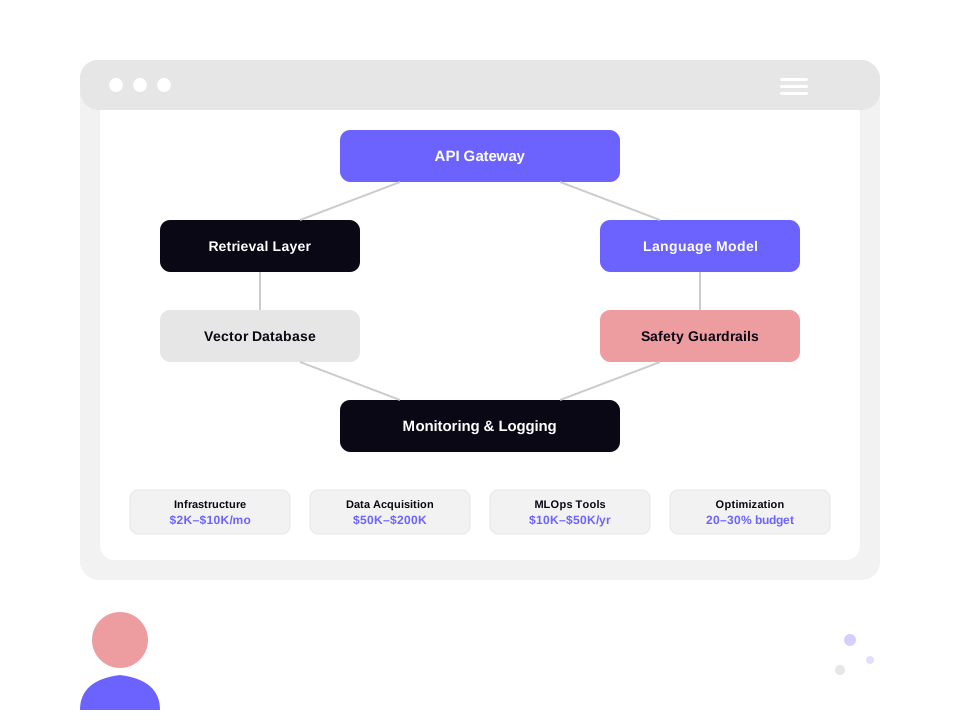
- Build a Feature Store and Vector Layer: Centralizing features in a store (and vectors in a purpose-built database) lets multiple teams share work, speeds up training runs, and keeps inference fast.

Choose and Train Your Model
There is no one-size-fits-all architecture. The right choice depends on your data type, latency needs, interpretability requirements, and how much labeled data you have. Here is how to think through the options.
- Classical ML vs. Deep Learning vs. LLMs: Gradient-boosted trees still beat neural nets on many tabular problems and are easier to explain. Deep learning shines on images, audio, and sequences. LLMs are the go-to when you need natural language understanding or generation.
- Fine-Tuning vs. RAG vs. Training From Scratch: Fine-tuning a pre-trained model gives strong results with less data. Retrieval-augmented generation keeps answers grounded in current documents. Training from scratch only makes sense when you have massive proprietary datasets and unique requirements.
- Hyperparameter Tuning and Transfer Learning: Automated search (Bayesian, grid, or random) plus transfer learning from related tasks can cut training time dramatically while improving final accuracy.
Evaluate Thoroughly, Ship Safely
A model that looks great on a held-out test set can still fail in production. Solid evaluation goes beyond accuracy: you need to test for robustness under edge cases, check for bias, and run adversarial probes -- all before real users see it.

- Multi-Angle Performance Testing: Measure accuracy, but also robustness to noisy inputs, fairness across demographic groups, and toxicity in generated text. One metric is never enough.
- Red-Teaming and Adversarial Probes: Dedicated testers try to break the model -- prompt injection, data poisoning, boundary-case exploitation. Finding weaknesses internally is far cheaper than finding them in production.
- A/B Tests Tied to Business KPIs: Run controlled experiments that connect model changes to revenue, conversion, or support-ticket volume. This is what actually proves the model is worth keeping.
Run It Like a Product With MLOps
Deploying a model is not the finish line -- it is the starting line. Without proper MLOps, models degrade silently as data drifts and business conditions change. Treat your AI system like a living product that needs continuous care.
- Version Everything: Track model weights, training data snapshots, and config files so you can reproduce any past result and roll back quickly if something goes wrong.
- Monitor and Detect Drift: Set up dashboards that track prediction distributions, feature distributions, and business metrics in real time. Automated alerts should fire when distributions shift beyond thresholds.
- Lock Down Access and Audit Trails: Role-based permissions, encrypted model artifacts, and immutable deployment logs keep you compliant and protect sensitive data throughout the lifecycle.

Roll Out in Phases
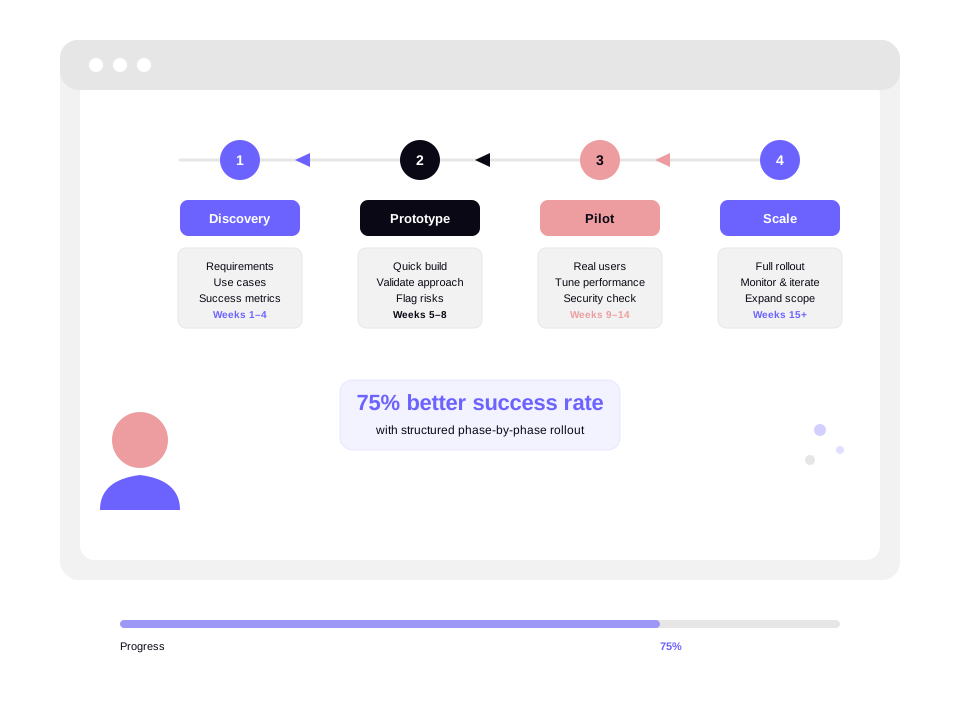
Phased rollouts reduce risk and build organizational confidence. Teams that follow a stage-gated process see about 75% higher success rates than those that try to go from idea to full deployment in one leap.
- Discovery: Align on the business case, define success metrics, assess feasibility, and get stakeholder buy-in. Skip this and you will waste months building something nobody asked for.
- Prototype: Build a rough working version fast. The goal is to validate that the approach can hit the target metrics -- not to ship polished software.
- Pilot: Put the model in front of real users in a controlled setting. Gather feedback, tune performance, and stress-test security before opening the gates.
- General Availability: Roll out to the full user base, stand up monitoring dashboards, and establish a feedback loop for continuous improvement.
Need a Hand?
We help teams go from messy data to production-grade AI models -- faster and with fewer surprises.
From problem definition to live monitoring, we will guide you through every phase.
Consult Our Experts