Key Takeaways
- A brute force attack is a trial-and-error method where attackers guess usernames, passwords, or encryption keys until they succeed — still accounting for over 20% of all authentication breaches in 2026.
- The six most common variants are simple, dictionary, hybrid, reverse, credential stuffing, and rainbow table attacks — each defeated by a different control layer.
- Defense-in-depth works best: strong passwords + MFA + rate limiting + CAPTCHA + WAF + monitoring reduces successful brute force attempts by 99%+.
- Passkeys, hardware tokens (FIDO2/WebAuthn), and zero-trust architectures are the 2026 gold standard — they eliminate password-based brute force entirely.
What Is a Brute Force Attack?
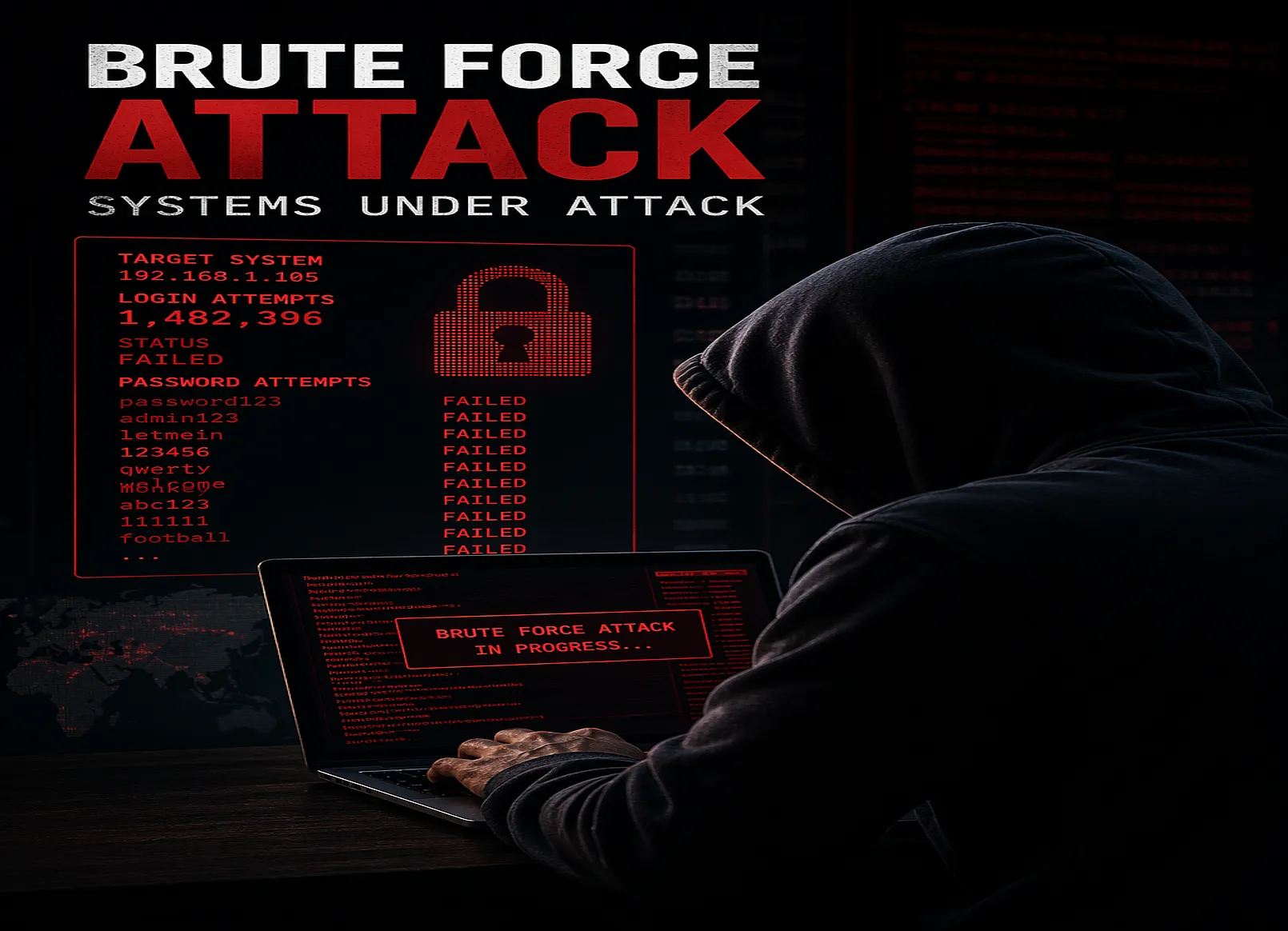
A brute force attack is a trial-and-error cyberattack in which a threat actor — or more commonly, an automated bot — systematically submits every possible combination of characters, words, or previously leaked credentials until the correct password, PIN, encryption key, or session token is discovered. Because the technique relies on sheer computational volume rather than exploiting a software vulnerability, it works against any authentication system that accepts unlimited guesses.
Brute force attacks remain among the most persistent threats in cybersecurity because they are easy to automate, require no special exploit research, and succeed whenever defenders neglect basic controls such as rate limiting, account lockout, and multi-factor authentication. According to the 2026 Verizon DBIR, brute force and credential-stuffing attacks contributed to roughly 44% of all basic web application breaches.
Why Brute Force Is Still a Top Threat in 2026
Three forces are making brute force attacks even more effective in 2026: cheap GPU compute on cloud platforms, 18+ billion leaked credentials circulating on dark-web markets, and AI-generated password lists that prioritize guesses based on target profiles. What used to take months now takes minutes against weak passwords.
- Cloud-scale cracking: Modern GPU clusters can attempt trillions of SHA-256 hashes per second.
- Credential leaks: Every re-used password exponentially expands the attack surface.
- AI-assisted guessing: LLMs build custom wordlists from social graphs, leaked breaches, and domain metadata.
- API-first targets: Unauthenticated login endpoints, REST, and GraphQL APIs are prime automation targets.
How Brute Force Attacks Work (Step-by-Step)
A typical brute force operation follows a predictable five-stage lifecycle. Understanding each stage is the first step in designing an effective cybersecurity defense strategy.
- 1. Reconnaissance: The attacker enumerates valid usernames, emails, or endpoints through OSINT, directory harvesting, or leaked data.
- 2. Wordlist preparation: A password dictionary — sometimes tens of billions of entries — is assembled from breach dumps, common passwords, and target-specific patterns.
- 3. Automated submission: Tools like Hydra, Medusa, or custom scripts spray guesses against the login endpoint, often through rotating proxies to avoid IP blocks.
- 4. Credential validation: A hit is logged; the attacker pivots to identify account privileges and connected systems.
- 5. Exploitation: Stolen access is monetized via ransomware deployment, data exfiltration, wire-fraud, or resold on dark-web marketplaces.
Is your login infrastructure exposed?
Get a free brute-force risk assessment for your web & API endpoints.
Request Free AssessmentTypes of Brute Force Attacks
Not all brute force attacks are identical. Defenders who recognize the specific variant in play can apply the right countermeasure. Below are the six most common types of brute force attacks observed in the wild in 2026.
1. Simple Brute Force Attack
The original form: the attacker tries every possible character combination (a, b, c, … aa, ab, ac, …) without any prior knowledge. Simple brute force is effective only against short or low-complexity passwords (under 8 characters) because the keyspace doubles with each added character.
2. Dictionary Attack
Rather than trying every combination, a dictionary attack submits entries from a prepared list — real words, common phrases, predictable substitutions (P@ssw0rd, qwerty123), and previously leaked passwords. It is orders of magnitude faster than simple brute force because it exploits human password habits.
3. Hybrid Brute Force Attack
A hybrid attack combines dictionary words with permutations and suffixes (e.g., summer → summer2026, Summer!, summer@123). This variant defeats users who think adding a number or symbol to a dictionary word is enough security.
4. Reverse Brute Force Attack
In a reverse brute force attack, the attacker starts with a known password — typically a leaked password like 123456 or Password1 — and tests it against thousands of usernames. Because many people reuse passwords, even a single weak credential can unlock dozens of accounts across unrelated services.
5. Credential Stuffing
Credential stuffing uses full email:password pairs harvested from prior data breaches. Bots test these combos across unrelated websites, betting on password reuse. It is the fastest-growing brute force variant — responsible for billions of fraudulent login attempts per day globally, and a leading cause of account takeover (ATO).
6. Rainbow Table Attack
A rainbow table attack targets leaked password hashes rather than live login forms. The attacker uses pre-computed tables that map billions of plaintext passwords to their cryptographic hashes, enabling near-instant reversal — unless the defender has correctly salted the hashes.
Real-World Brute Force Attack Examples
Brute force attacks are not theoretical. These real breaches show how costly insufficient authentication hardening can be.
- Alibaba (2016): 99 million accounts brute-forced using leaked credentials — one of the largest credential stuffing campaigns on record.
- GitHub (2013 & recurring): Attackers repeatedly targeted developer accounts; GitHub later mandated MFA for all maintainers.
- Canva (2019): 139 million user records exposed; reused passwords were immediately credential-stuffed against other platforms.
- T-Mobile (2023): A brute-forced API endpoint exposed data on 37 million customers, resulting in a $350M settlement.
- Okta (2022): Attackers used credential stuffing against customer support portals, foreshadowing a wave of downstream SaaS breaches.
Common Tools Attackers Use
Brute force tooling is openly available — which is precisely why defenders must assume attackers are always well-equipped. Blue teams benefit from knowing the most common offensive utilities so they can harden against each.
- Hydra: Multi-protocol network login cracker (SSH, FTP, HTTP forms, RDP, and 50+ more).
- Medusa: Parallel, modular, speed-optimized brute forcer.
- Hashcat & John the Ripper: Offline hash crackers leveraging GPUs.
- Burp Suite Intruder: Web-focused brute force against forms, API parameters, and tokens.
- Sentry MBA / OpenBullet: Specialized credential stuffing suites popular on fraud forums.
Business Impact of a Successful Brute Force Attack
A compromised account is rarely the endgame. Attackers pivot from initial access to much larger objectives — and the downstream costs compound quickly.
- Data breach & regulatory fines: GDPR, HIPAA, PCI-DSS, and SOC 2 exposure can trigger fines of 2–4% of global revenue.
- Ransomware deployment: 80% of modern ransomware incidents begin with a brute-forced or stolen credential.
- Reputation & customer trust loss: Post-breach churn averages 12–18% among consumer brands.
- Fraud & financial loss: Account takeover fraud cost businesses an estimated $16B+ globally in 2025.
- Operational downtime: Forensics, incident response, and system rebuilds average 21 days of disruption.
Defense-in-depth matters
Harden your authentication stack before attackers find it.
Talk to a Security Engineer10 Proven Ways to Prevent Brute Force Attacks
No single control stops every brute force variant. The goal is defense-in-depth — layered controls where an attacker must defeat multiple independent barriers. These ten measures, deployed together, reduce successful brute force attempts by more than 99%.
1. Enforce Strong Password Policies
Require passphrases of at least 14 characters with a mix of upper, lower, digits, and symbols. Block common passwords using lists like HaveIBeenPwned's 1B+ breached-password API. Encourage password managers so users can comply without re-using.
2. Require Multi-Factor Authentication (MFA)
MFA is the single most effective brute force mitigation — Microsoft research shows it blocks 99.9% of automated account compromise attacks. Prefer phishing-resistant methods: FIDO2 security keys, platform authenticators (Touch ID, Windows Hello), or push-based authenticators. Avoid SMS where possible.
3. Implement Rate Limiting & Throttling
Cap login attempts per IP, per user, and per session. Exponential back-off (1s, 2s, 4s, 8s…) neutralizes high-speed scripts without harming legitimate users. Apply rate limits at the edge/WAF layer as well as in the application.
4. Enable Smart Account Lockouts
Temporarily lock accounts after 5–10 failed attempts. Modern implementations use risk-based lockout — factoring device reputation, IP geolocation, and velocity — to avoid denial-of-service on legitimate users while still blocking bots.
5. Deploy CAPTCHA & Bot Detection
Invisible challenges (hCaptcha Enterprise, Cloudflare Turnstile, reCAPTCHA v3) score each request and challenge suspicious traffic without inconveniencing humans. Combine with device fingerprinting and behavioral biometrics for stronger bot-vs-human separation.
6. Use a Web Application Firewall (WAF)
Cloud WAFs (AWS WAF, Cloudflare, Akamai) detect and block high-volume login patterns, known malicious IPs, and credential-stuffing signatures at the network edge — before traffic ever reaches your application. Our cloud security engineers integrate WAF, bot management, and CDN policies in a single control plane.
7. Monitor Logs & Set Anomaly Alerts
Stream authentication logs into a SIEM (Splunk, Elastic, Sentinel) and alert on anomalies: spikes in failed logins, geo-velocity impossibilities, or sudden drops in success rate. A well-tuned SOC detects credential-stuffing campaigns within minutes.
8. Adopt Passwordless & Passkey Authentication
Passkeys (WebAuthn / FIDO2) replace passwords with device-bound cryptographic keys. Because there is no shared secret to guess, the entire category of brute force attack becomes mathematically impossible. Apple, Google, and Microsoft now support passkeys natively — adopt them wherever possible.
9. Apply Zero-Trust Network Access
Never trust authentication alone. A zero-trust architecture continuously verifies identity, device posture, network context, and application behavior for every request. Compromised credentials still need to defeat device attestation, mTLS, and step-up MFA before access is granted.
10. Educate Users & Run Security Drills
Even the best controls lose value if users reuse passwords, fall for phishing, or disable MFA. Ongoing security-awareness training, simulated phishing campaigns, and tabletop incident response exercises materially reduce breach risk.
Detecting an Ongoing Brute Force Attack
Early detection dramatically shortens attacker dwell time. Watch for these high-signal indicators of compromise (IoC):
- Sudden surge in failed-login events on one endpoint, particularly from many distinct IPs.
- Uniform user-agent strings or headless browser signatures (e.g., PhantomJS, headless Chrome) in login traffic.
- Geo-velocity impossibilities — a user logging in from Mumbai and São Paulo within minutes.
- Steady, low-volume trickle across many accounts (slow-and-low credential stuffing) — easy to miss without behavioral analytics.
- Password-reset or account-recovery bursts following a spike in failed logins.
An AI-augmented SOC that correlates these signals in real-time can shut down a brute force campaign before a single account is compromised.
Brute Force Attack FAQ
How long does a brute force attack take?
It depends on password length and complexity. A 6-character lowercase password can be brute-forced in seconds. A 12-character mixed-case, numeric, symbol password takes modern GPUs roughly 34,000 years — which is why length and complexity matter so much.
Is a brute force attack illegal?
Yes. Attempting to brute force a system you do not own or have explicit written authorization to test violates the U.S. Computer Fraud and Abuse Act (CFAA), the UK Computer Misuse Act, India's IT Act, and similar laws in most jurisdictions. Authorized penetration testing is legal — unauthorized brute force is not.
Can brute force attacks be detected?
Absolutely. Any organization with proper log aggregation, a modern WAF, and an AI-augmented SIEM should be able to detect brute force attacks within minutes. The key is correlating failed-login patterns, IP reputation, user-agent anomalies, and velocity metrics.
Does MFA completely prevent brute force attacks?
MFA blocks roughly 99.9% of credential-based attacks, but it is not an absolute silver bullet. MFA fatigue (push bombing), SIM swapping (for SMS-based MFA), and session hijacking are active bypass techniques. Prefer phishing-resistant MFA (FIDO2 security keys, passkeys) for the strongest defense.
What is the difference between brute force and credential stuffing?
Brute force tries many passwords against one account. Credential stuffing tries one leaked email:password pair against many sites, hoping the user reused the password. Credential stuffing is the more common attack today because of the enormous supply of breached data.
Protect Your Business with Bonami Software
Brute force attacks will continue to evolve — faster hardware, bigger leaked datasets, and AI-assisted password guessing mean defenders cannot stand still. Building a layered, zero-trust authentication architecture is the most effective long-term answer.
At Bonami Software, our cloud security engineers and AI security specialists help enterprises design and deploy brute-force-resilient authentication: MFA roll-outs, passkey migration, WAF and bot-management tuning, SIEM correlation rules, and SOC-as-a-service operations. Whether you need a one-time security audit or a multi-year security program, we deliver measurable risk reduction.
Ready to lock down your authentication stack?
Book a free 30-minute consultation with our security team. We'll review your current controls, identify the highest-risk gaps, and deliver a prioritized hardening roadmap — no obligation.