
See what our clients say about working with Bonami Software across 200+ projects for 18+ industries. EXPLORE NOW!
We don't just build software. We deliver results. EXPLORE NOW!
See why businesses choose Bonami Software for reliable, scalable solutions. EXPLORE NOW!
We turn ideas into scalable products with proven delivery across 18+ industries. EXPLORE NOW!
See what our clients say about working with Bonami Software across 200+ projects for 18+ industries. EXPLORE NOW!
We don't just build software. We deliver results. EXPLORE NOW!
See why businesses choose Bonami Software for reliable, scalable solutions. EXPLORE NOW!
We turn ideas into scalable products with proven delivery across 18+ industries. EXPLORE NOW!

How AI Is Used in Healthcare.

A practical look at where AI delivers results in 2026 — diagnostics, documentation, monitoring, and personalized care.

BrowserStack
Persistent
Yatra
Kellton
Jade Global
Optum
PokerBaazi
Walmart
Turing
BrowserStack
Persistent
Yatra
Kellton
Jade Global
Optum
PokerBaazi
Walmart
Turing

Talk to Our Healthcare AI Team

Share your workflows and we'll map the highest-ROI AI use cases — reply within 24 hours.

  • Your idea is 100% protected by our NDA
BrowserStack
Persistent
Yatra
Kellton
Jade Global
Optum
PokerBaazi
Walmart
Turing
BrowserStack
Persistent
Yatra
Kellton
Jade Global
Optum
PokerBaazi
Walmart
Turing

Where AI Is Actually Used in Healthcare

AI in healthcare uses machine learning, NLP, computer vision, and predictive analytics to improve care and reduce cost — deployed across four domains with measurable gains in quality and productivity.

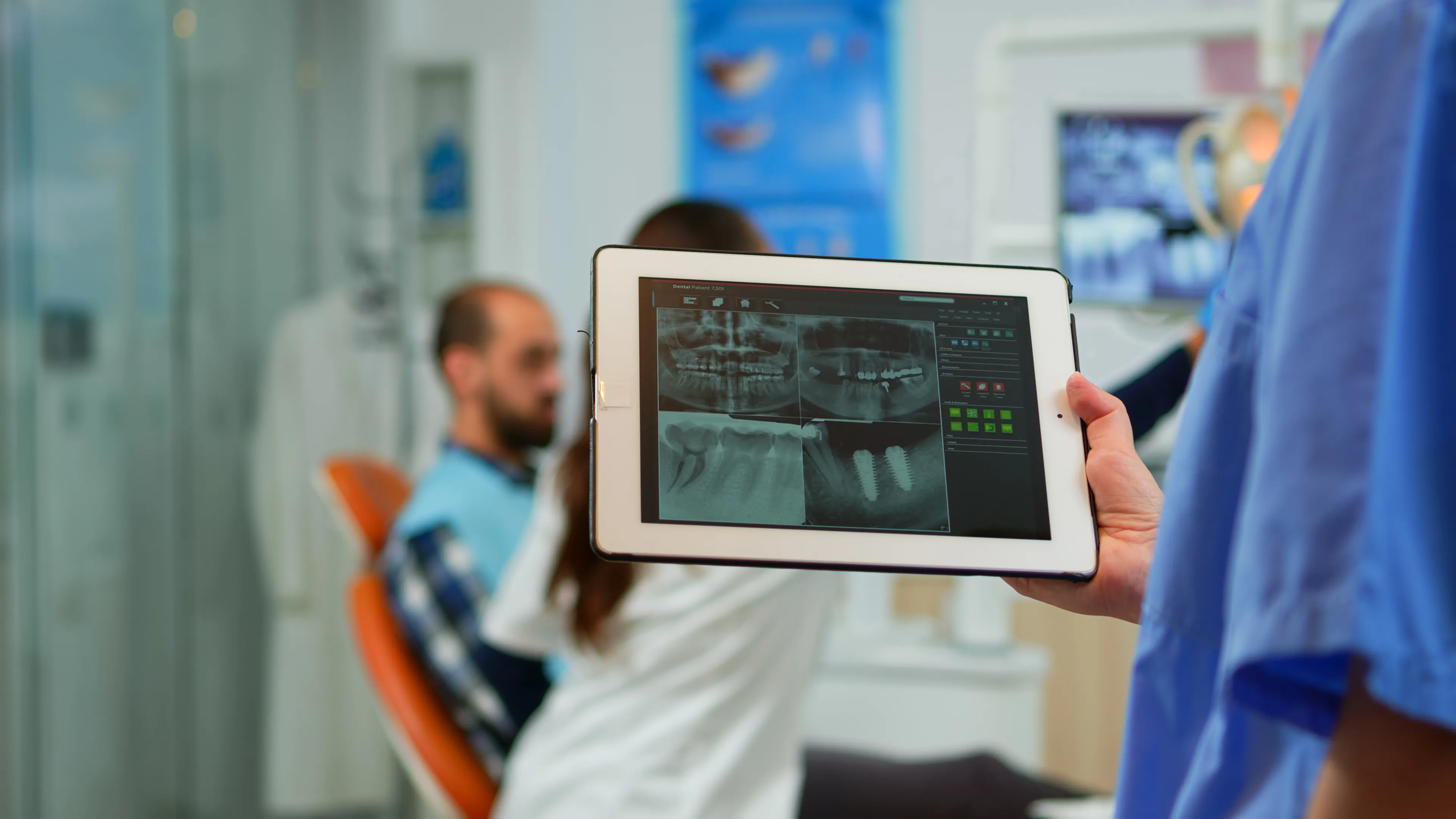
AI in healthcare — medical imaging analysis, predictive analytics, and connected patient monitoring
🔬

AI in Medical Diagnostics

AI analyzes X-rays, CT, MRI, and pathology slides to flag cancer, cardiovascular, and neurological conditions early. AI-assisted mammography cuts false negatives by up to 20%.

⚙️

Healthcare Automation AI

Scheduling, billing, claims, and prior authorization automated end-to-end. Ambient AI scribes save clinicians 2+ hours daily; AI medical coding hits 94%+ first-pass acceptance.

📡

Real-Time Patient Monitoring

Wearables and sensors feed AI engines that flag deterioration early. Predictive sepsis models alert 6–12 hours sooner, cutting 30-day readmissions by 20–25%.

🧬

Personalized Treatment

AI correlates history, genomics, and lifestyle data to recommend precision oncology, pharmacogenomic dosing, and risk stratification — improving outcomes and reducing adverse reactions.

🧠

Clinical Decision Support

Multimodal models combine imaging, EHR notes, and labs to surface high-priority cases first — reducing clinician fatigue and retraining on outcomes to stay current with new disease patterns.

The Numbers Behind AI in Healthcare

Hover to explore why AI adoption is accelerating across hospitals, labs, payers, and health-tech.

How AI Is Used Across the Medical Industry

AI operates at two layers — point of care and back office. Here is what it does in each.

Can AI Improve Diagnostic Accuracy?

Yes — consistently. AI improves accuracy by analyzing data at a scale no clinician can, augmenting rather than replacing the care team.

Pattern Recognition at Scale

AI compares scans against millions of prior cases to flag anomalies a single reader could miss — surfacing urgent cases first and reducing false negatives and clinician fatigue.

Multimodal Reasoning

Modern models combine imaging, EHR notes, labs, and genomics into one diagnostic picture — reducing misdiagnosis and supporting faster clinical decisions.

Continuous Learning

Models retrain on outcomes data to stay current with new disease patterns, compounding accuracy over time. Successful deployments treat AI as a decision-support layer for the whole care team.

What AI Delivers in Real Healthcare Settings

Each outcome ties to a specific use case — diagnostics, documentation, monitoring, or revenue cycle.

Book a Healthcare AI Consultation
95%
Diagnostic accuracy achievable with AI-assisted medical imaging on early cancer, cardiovascular, and neurological detection.
2+ hrs
Saved per clinician per day with ambient AI documentation — time returned to patient care instead of the keyboard.
20%
Fewer false negatives on AI-augmented mammography — earlier detection, better survival rates, lower treatment cost.
25%
Reduction in 30-day readmissions through AI-driven remote monitoring and post-discharge check-ins.
94%+
First-pass acceptance rate with AI medical coding (CPT/ICD-10) — fewer denials and shorter days-in-AR.
30%
Lower no-show rates with predictive scheduling that analyzes patient history and outreach timing.

Who Is Putting AI to Work in Healthcare

AI is embedded in core clinical and administrative workflows across the ecosystem. Hover to see where it delivers most.

  • Hospitals & Health Systems

    Hospitals & Health Systems

    Hospitals & Health Systems

    Clinical decision support, ambient documentation, imaging triage, and operational forecasting — improving outcomes and productivity while controlling cost.

  • Diagnostic Labs & Imaging Centers

    Diagnostic Labs & Imaging Centers

    Diagnostic Labs & Imaging Centers

    AI as a second reader for radiology and pathology — flagging high-priority cases and cutting turnaround at scale.

  • Payers & Insurers

    Payers & Insurers

    Payers & Insurers

    Automated claims adjudication, fraud scoring, and prior authorization — faster settlements, lower loss ratios, fewer denials.

  • Digital Health & Health-Tech

    Digital Health & Health-Tech

    Digital Health & Health-Tech

    AI-native remote monitoring, digital therapeutics, and triage assistants built on HIPAA-grade infrastructure.

  • Pharma & Life Sciences

    Pharma & Life Sciences

    Pharma & Life Sciences

    Drug discovery, trial matching, pharmacogenomics, and real-world evidence — compressing timelines across the research pipeline.

What It Takes to Deploy AI in Healthcare Safely, Compliantly, and at Scale

AI in healthcare must be secure, transparent, and ethically implemented across every framework governing patient data and medical software.

Data Privacy & Security

Patient Data Protection

Encrypted pipelines, signed BAAs, audit logging, and de-identification are non-negotiable for healthcare AI.

  • HIPAA Privacy & Security Rules
  • GDPR
  • HITRUST
  • SOC 2 Type II
Integration

EHR & Interoperability

Most AI value depends on clean integration with existing clinical systems — API work, not rip-and-replace.

  • Epic / Cerner / Meditech
  • HL7 v2 & FHIR R4
  • DICOM Imaging
  • Allscripts
Regulatory

Medical Device Pathways

Clinical-grade AI often requires regulatory clearance. Getting the pathway right early avoids costly delays.

  • FDA SaMD Clearance
  • CE Marking
  • Clinical Validation
  • Post-Market Surveillance
Model Governance

Accuracy, Bias & MLOps

Models must be validated across demographic groups and monitored in production — auditable and continuously governed.

  • Bias & Fairness Testing
  • Explainability
  • Model Monitoring
  • Drift Detection
Clinician Adoption

Built Into the Workflow

AI tools must be explainable and embedded in existing workflows. The best deployments earn clinician trust by augmenting, not interrupting.

  • Workflow-Native UX
  • Sub-Second Response
  • Clinical Advisory Input
  • Human-in-the-Loop
Coding Standards

Clinical Classification

Coding standards validated at every clinical and billing touchpoint.

  • ICD-10-CM / ICD-10-PCS
  • CPT
  • SNOMED CT
  • LOINC
Bring AI Into Your Healthcare Organization.

The right AI healthcare partner combines clinical knowledge, HIPAA-compliant engineering, and proven delivery. Our engineers help hospitals, payers, and health-tech teams design and deploy compliant AI — imaging models, clinical decision support, ambient documentation, RCM automation, and EHR-integrated copilots.

Schedule a Free Consultation
AI Readiness

Award-Winning AI Development & Consulting

2025

100 Fastest Growth Companies

2025

Global Spring Winner

2025

Top App Development Company

2024

AWS Partner Network

2024

Google Cloud Partner

2025

Highly Rated on Trustpilot

2024

Verified Agency

2024

Top App Development Company

2024

ASSOCHAM Member

AI in Healthcare FAQ

[ 1 ]

How is AI changing the medical industry in 2026?

AI is reshaping every layer of the medical industry — diagnostics, imaging, administrative automation, drug discovery, and personalized medicine. The result is faster diagnosis, lower costs, and better patient outcomes.

[ 2 ]

Will AI replace doctors?

No. AI handles repetitive tasks — image triage, documentation, data lookup — so doctors can focus on judgment and complex decisions. Studies consistently show clinicians and AI together outperform either alone.

[ 3 ]

Is AI in healthcare HIPAA compliant?

Yes, when built correctly — with encrypted pipelines, signed BAAs, audit logging, role-based access, and de-identification. Choose vendors with proven HIPAA, HITRUST, and SOC 2 credentials.

[ 4 ]

How long does it take to deploy a healthcare AI solution?

A focused MVP — triage assistant or claims-coding tool — can launch in 8–16 weeks. Enterprise deployments like EHR-integrated copilots or FDA-cleared diagnostic devices typically run 6–18 months.

[ 5 ]

How much does it cost to build healthcare AI solutions?

Costs range from ~$50K for a proof-of-concept to $500K+ for fully integrated, regulatory-cleared platforms — depending on data complexity, EHR integrations, and MLOps requirements.


Global presence

Two offices. One team.

Hi, I'm ARIA. Ask me anything about Bonami's AI agents.