
See what our clients say about working with Bonami Software across 200+ projects for 18+ industries. EXPLORE NOW!
We don't just build software. We deliver results. EXPLORE NOW!
See why businesses choose Bonami Software for reliable, scalable solutions. EXPLORE NOW!
We turn ideas into scalable products with proven delivery across 18+ industries. EXPLORE NOW!
See what our clients say about working with Bonami Software across 200+ projects for 18+ industries. EXPLORE NOW!
We don't just build software. We deliver results. EXPLORE NOW!
See why businesses choose Bonami Software for reliable, scalable solutions. EXPLORE NOW!
We turn ideas into scalable products with proven delivery across 18+ industries. EXPLORE NOW!

Fine-Tuned AI Models for Healthcare

Generic AI gives every competitor the same tools. Fine-tuned models — trained on your clinical data, patient population, and workflows — give you an edge no one can copy.

BrowserStack
Persistent
Yatra
Kellton
Jade Global
Optum
PokerBaazi
Walmart
BrowserStack
Persistent
Yatra
Kellton
Jade Global
Optum
PokerBaazi
Walmart

Start a Conversation

Tell us about your data and use case. We reply within 24 hours.

  • We respond within 24 hours, fully NDA-protected.
BrowserStack
Persistent
Yatra
Kellton
Jade Global
Optum
PokerBaazi
Walmart
BrowserStack
Persistent
Yatra
Kellton
Jade Global
Optum
PokerBaazi
Walmart

What Fine-Tuned AI Means in Healthcare

Generic AI knows that diabetes exists, what HbA1c is, and roughly how insulin works. Fine-tuned AI knows what that looks like in your specific patient population — and produces results no generic model can replicate.

Fine-tuned AI models for healthcare organisations
🤖

Generic AI Is a Commodity

Any healthcare company can buy access to the same foundation models. When your competitors are using the same underlying AI on the same types of data, you are not differentiating — you are commodifying.

🔒

Your Data Is Your Moat

Fine-tuned AI trained on your clinical data, your patient population, your operational patterns produces capabilities a competitor cannot replicate without access to the same proprietary data and the same tuning process.

🎯

Specificity Creates Clinical Usefulness

A model that has learned the patterns in your specific context — your EHR terminology, your care pathways, your disease prevalence — is not just technically impressive. It is clinically useful in ways a generic model never will be.

Our Process

What Fine-Tuned AI Delivers

Measurable, documented, defensible results — across every dimension of clinical AI. Drag, click a card, or use the dots to explore each dimension.

Proprietary Ownership
The fine-tuned model, training pipeline, and validation framework are proprietary assets you own — not a vendor dependency you rent.
HIPAA-Compliant Training
PHI is de-identified before it enters the training process. Every pipeline is built compliant by default, with audit-ready data handling throughout.
Head-to-Head Validation
Every fine-tuned model is benchmarked against a generic baseline on held-out clinical cases — reviewed by subject matter experts before deployment.
Clinical Documentation
Notes tuned to your specialty, your EHR, and your documentation standards — not a generic template that sounds like a different physician wrote it.
Diagnostic Support
Recommendations calibrated to your patient population — not population averages. A model trained on your data produces more accurate outputs for your patients.
Risk Stratification
Risk models tuned to your member population, provider network, and geography — translating directly into better resource allocation and earlier intervention.
Revenue Cycle AI
Coding and billing AI fine-tuned on your payer mix and contract terms — not average claims. Fewer denials, faster adjudication, higher collection rates.
Drift Monitoring
Clinical AI drifts as populations and guidelines change. We build monitoring that flags retraining needs before degradation reaches your users.

Real Healthcare Outcomes

Clinicians spending 3+ hours/day on charting

We built an AI-assisted practice management system that cut the documentation burden dramatically, giving clinicians their time back.

70% Reduction in documentation time
Clinicians spending 3+ hours/day on charting
Get a Free Discovery Call

Claim denial rates above 18%

We rebuilt the revenue cycle workflow end to end — denials, authorizations, and coding — to recover revenue that was leaking out of the system.

98% Collection rate achieved
Claim denial rates above 18%
Get a Free Discovery Call

High patient no-show rates

A telehealth platform with smart scheduling, reminders, and follow-up that brought patients back into their care plans.

45% Fewer missed appointments
High patient no-show rates
Get a Free Discovery Call

Slow manual image assessment

A purpose-built DICOM viewer and radiology workflow that sped up review without sacrificing diagnostic confidence.
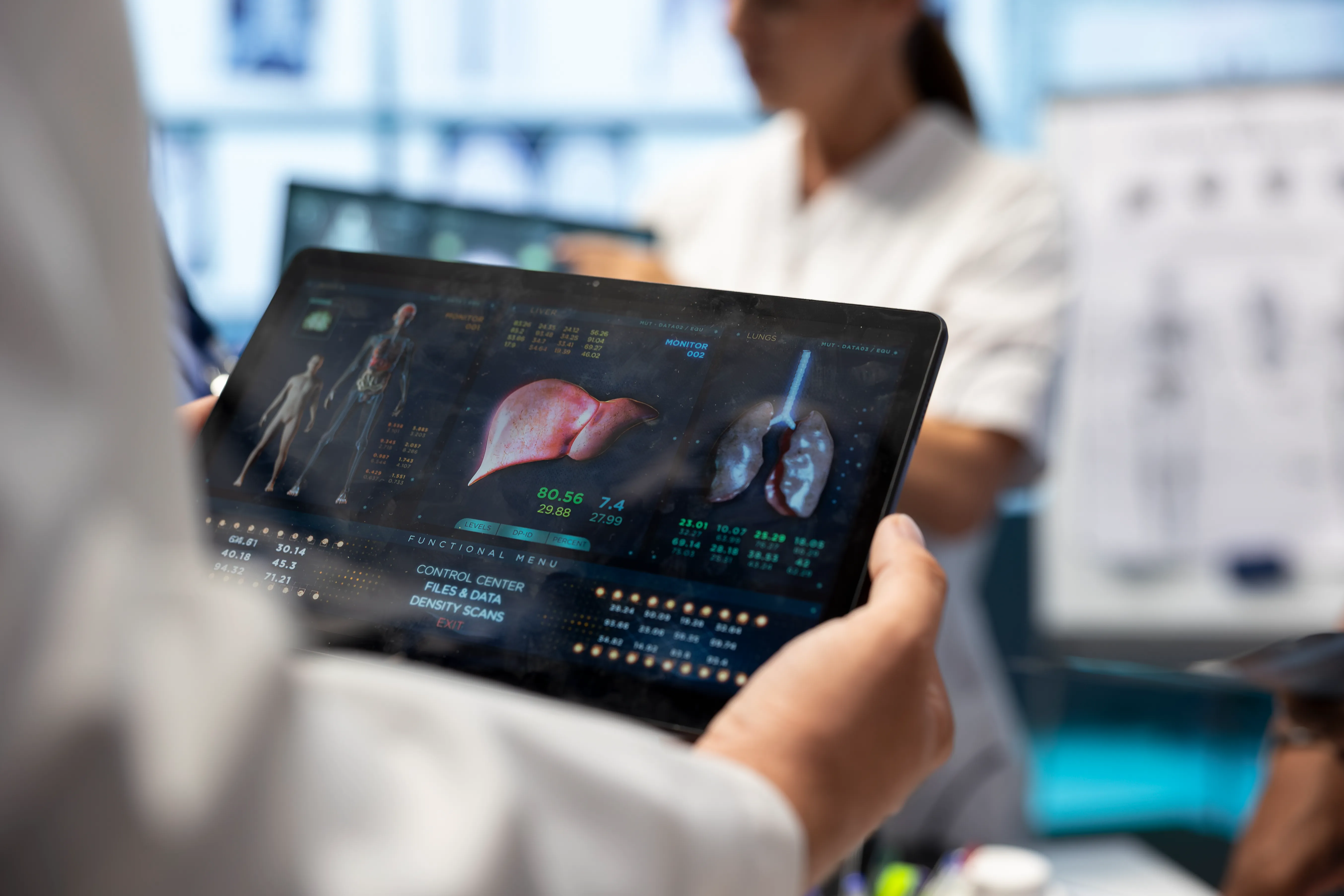
83% Faster radiologist review
Slow manual image assessment
Get a Free Discovery Call

16-step manual treatment tracking

We replaced a 16-step manual treatment process with a guided lifecycle platform that kept patients on track to completion.

88% Treatment completion rate
16-step manual treatment tracking
Get a Free Discovery Call

25 disconnected clinic locations

We unified 25 separately-reporting dental locations under one platform with real-time, cross-location visibility.

25→1 Locations unified under one platform
25 disconnected clinic locations
Get a Free Discovery Call

The Fine-Tuning Process

How we go from a foundation model to a vertically differentiated AI capability. Hover or tap a step to see what happens inside it.

  • Step 1 — Use Case Definition

    Step 1 — Use Case Definition

    Step 1 — Use Case Definition

    We define exactly what the AI needs to do, what good output looks like, and what data is available. Precision here determines quality throughout.

  • Step 2 — Data Preparation

    Step 2 — Data Preparation

    Step 2 — Data Preparation

    We extract, de-identify, clean, and structure your clinical data for training — fully compliant with applicable privacy regulations.

  • Step 3 — Model Selection and Fine-Tuning

    Step 3 — Model Selection and Fine-Tuning

    Step 3 — Model Selection and Fine-Tuning

    We pick the right foundation model for your task and fine-tune it on your prepared data using techniques matched to the use case.

  • Step 4 — Clinical Validation

    Step 4 — Clinical Validation

    Step 4 — Clinical Validation

    Every model is tested against real clinical cases and reviewed by experts. Nothing ships without passing the criteria set in step one.

  • Step 5 — Deployment and Monitoring

    Step 5 — Deployment and Monitoring

    Step 5 — Deployment and Monitoring

    Models go live with monitoring built in. We flag retraining needs before drift affects your users.

What You Own at the End

The fine-tuned model, the training pipeline, the validation framework, the monitoring infrastructure. Proprietary assets that a competitor cannot access without going through the same process.

Start a Conversation
Yours
The fine-tuned model — trained on your data, tuned to your clinical context, producing outputs calibrated to your specific use case.
Pipeline
The training pipeline — a repeatable process for retraining when your data grows or your requirements evolve, without starting from scratch.
Validated
The validation framework — documented evaluation criteria and held-out test sets that let you measure performance objectively at any point.
Monitored
The monitoring infrastructure — drift detection and performance tracking that tells you when a model needs retraining before it affects your users.

Who This Is For

Fine-tuned AI makes the most difference when your competitive advantage depends on the quality of your AI outputs — and when you have proprietary data that a generic model has never seen.

Healthcare SaaS Companies

Health Plans and Insurers

Hospital Networks and Health Systems

Digital Health Platforms

The AI in Your Product Should Be as Specific as the Problem It Solves

Generic models for generic problems. Fine-tuned models for the specific clinical and operational realities of your organisation.

Start a Conversation

AI Readiness

Award-Winning AI Development & Consulting

2025

100 Fastest Growth Companies

2025

Global Spring Winner

2025

Top App Development Company

2024

AWS Partner Network

2024

Google Cloud Partner

2025

Highly Rated on Trustpilot

2024

Verified Agency

2024

Top App Development Company

2024

ASSOCHAM Member

Frequently Asked Questions

[ 1 ]

How much data do we need for fine-tuning to be worthwhile?

It depends on the task. Some fine-tuning approaches work well with relatively small, high-quality datasets. Others require larger volumes. We assess what you have during discovery and recommend the approach that will produce the best results given your data reality — which sometimes means a different technique than fine-tuning, and sometimes means a data augmentation strategy before tuning.

[ 2 ]

What happens to our patient data during the fine-tuning process?

Patient data is de-identified before it is used in any training process, in compliance with HIPAA and applicable Indian data privacy regulations. De-identification is handled by us or in collaboration with your compliance team, and the process is documented for your regulatory records.

[ 3 ]

How do we know if the fine-tuned model is actually better than a generic one?

We run head-to-head evaluations on held-out clinical cases — comparing the fine-tuned model's outputs to the generic model's outputs, evaluated against clinical accuracy criteria defined with your subject matter experts. The improvement is measurable and documented before deployment.

Global presence

Two offices. One team.

Hi, I'm ARIA. Ask me anything about Bonami's AI agents.