



Charges From Clinical Events
Captured at the point of care.








From real-time clinical event monitoring and automated charge generation to CDM integrity, high-cost supply tracking, and charge lag surveillance.
Monitors EHR FHIR R4 orders, notes, and meds — applying charge logic instantly.
Auto-generates the CDM charge the moment a billable order completes.
Reconciles OR supplies against the charge sheet — flags missing implants.
Validates every CDM entry against CPT/HCPCS and CMS fee schedules.
Real-time charge lag dashboard by provider, department, and encounter type.
Compares expected vs captured charges per service line, daily by department.
The HFMA benchmark is clear: charge capture failures drain 1–3% of net patient revenue annually — through services rendered without charges captured, not through billing errors or payer disputes.
Get Charge Assessment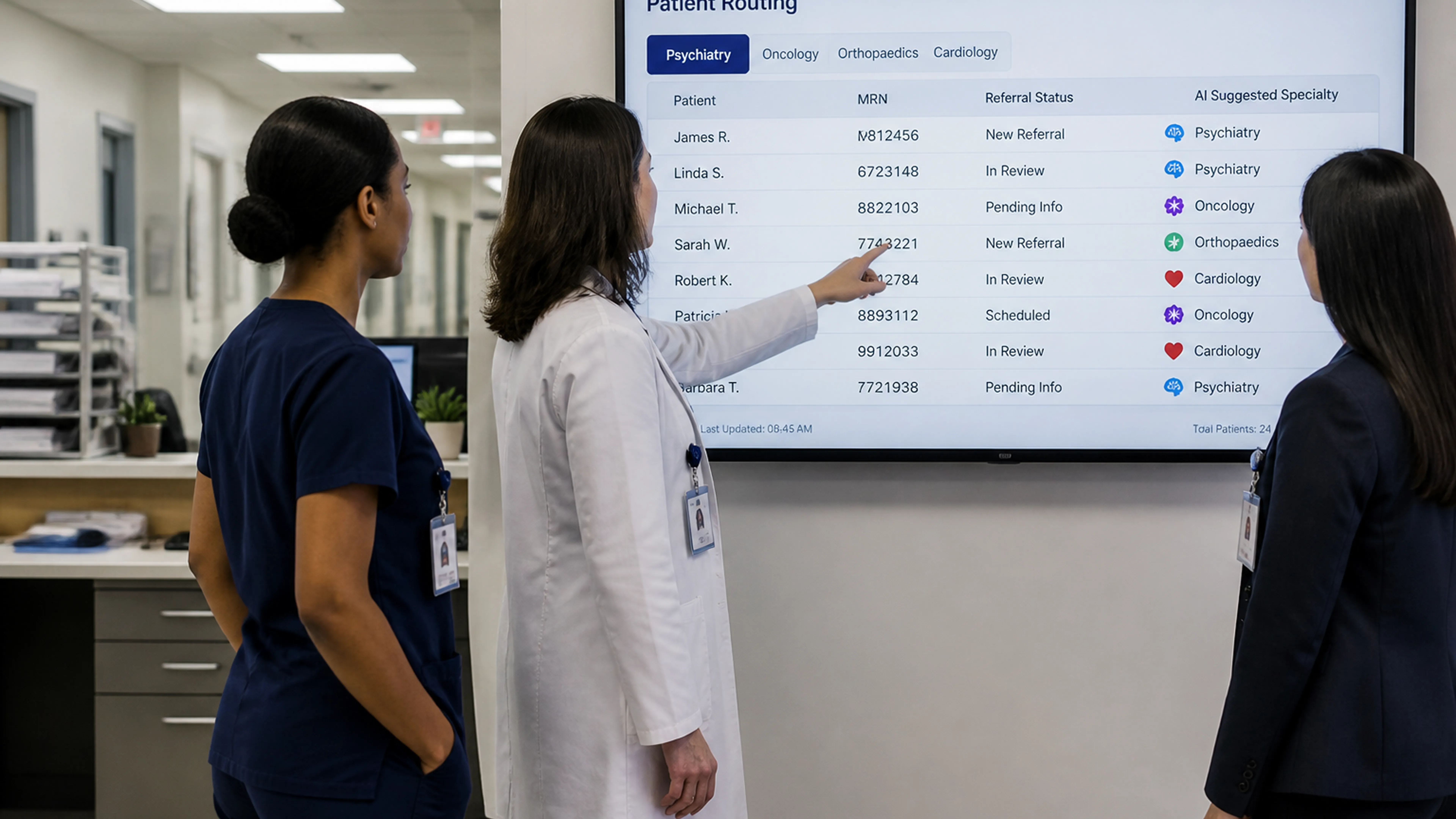
of net patient revenue is lost every year to charge capture failures — not billing errors or payer disputes.
HFMA / Advisory Board benchmark$3M–$9M in services already delivered and documented — never billed — at a $300M-net-revenue hospital.
Most of it never reaches the billing department. It is lost at the point of care: a service documented but no charge triggered, an implant used but not scanned, a note signed after discharge with nobody watching the clock.
Drag or tap the dots to explore.
The AI Charge Capture Agent connects to leading EHR, materials management, and revenue cycle billing platforms.
Epic EHR integration for automated charge capture and generation
Oracle Health Cerner integration for inpatient charge capture
Availity integration for pre-submission charge validation
athenahealth integration for ambulatory charge capture and CDM
eClaimLink UAE integration for DHA and HAAD charge capture
Daman UAE integration for charge capture and revenue integrity
Insights on autonomous charge capture across hospital and ambulatory care.

A practical, step-by-step guide to automating the revenue cycle end to end — from charge capture through denial management.
Read the article
How NLP and machine learning read clinical notes to assign accurate codes and cut manual coding review time.
Read the article
What to evaluate — EHR integration depth, compliance posture, and deployment track record — before you commit.
Read the articleReal deployments applying AI in revenue cycle management across billing, coding, and collections — not projected numbers.
 98% Collection Rate
 An RCM dashboard traced every dollar from service to payment — lifting collections from 78% to 98% and recovering $275K.
 15-Day Reimbursement
 Automated CDT/CPT/ICD-10 claim generation and EOB reconciliation compressed cash cycles and lifted coding accuracy to 98%.
 $180K Risk Prevented
 A cross-coding validation engine blocked impossible CDT/CPT/ICD-10 pairings, lifting first-pass claim acceptance from 65% to 94% with zero audit findings.
Every missed charge, every late entry past the filing window, every implant documented in the operative report but absent from the charge sheet — each represents care your clinicians delivered and your health system absorbed without reimbursement.
Book Charge Capture Demo
A quick recap of the six capabilities that close revenue leakage automatically.
Monitors EHR FHIR R4 orders, notes, and meds — applying charge logic instantly.
Auto-generates the CDM charge the moment a billable order completes.
Reconciles OR supplies against the charge sheet — flags missing implants.
Validates every CDM entry against CPT/HCPCS and CMS fee schedules.
Real-time charge lag dashboard by provider, department, and encounter type.
Compares expected vs captured charges per service line, daily by department.
Get in touch
Get a live Charge Capture Agent demo and revenue leakage assessment.
Charge capture is the process of turning a delivered clinical service into a billable charge. When it fails, the service was still delivered — the health system just never gets paid for it.
Coding gets the ICD-10 and CPT right; charge capture makes sure the charge exists at all. The agent detects billable events from documentation.
Inpatient and critical care, OR/surgical with implants and supplies, emergency/ICU, and outpatient E/M with infusion reconciliation.
A three-way reconciliation across materials management, case cart, and operative note, with HCPCS L-code validation on high-cost implants.
Open encounters are tracked against a per-payer deadline matrix and escalated to revenue integrity at 30, 14, and 7 days out.
The agent applies the 2021 AMA medical decision-making framework to the signed note and attaches supporting MDM elements for audit defence.
FHIR R4 with Epic, Oracle Health/Cerner, athenahealth, NextGen, and eClinicalWorks; supply chain via HL7 v2; eClaimLink and TPA APIs in the UAE.
Missed charge rates fall from 1–3% toward 0.2–0.5% of net revenue, and most deployments recover full investment within 3–5 months.
Yes. Specialists move from manual sampling to exception queues, and the agent reuses your CDI query process to avoid duplicate queries.
Outsourced charge capture services still depend on a person reviewing each encounter after the fact. Bonami's charge capture software generates charges from signed documentation the moment it's written and reconciles daily — no review
Yes. Charge gap alerts follow clinicians wherever they document, and charges post to medical billing via the EHR charge entry API.
This agent is one of 32 built and maintained by Bonami X AI, our production AI agent division. If you want an agent like this scoped for your own workflow, our AI agent development company team handles discovery, build, integration, and support end to end.