
Key Takeaways
- Agentic AI is artificial intelligence that pursues a goal by planning steps, calling software tools, observing the results, and adjusting until the goal is met or a human checkpoint is reached. A chatbot answers. An agentic system completes work.
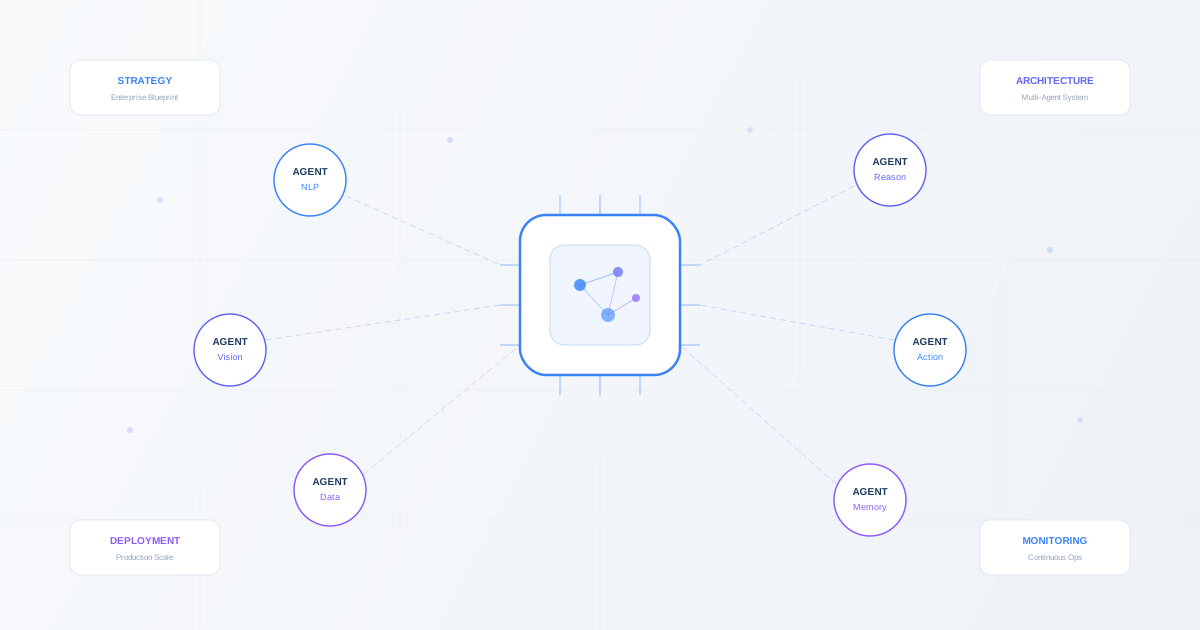
- The architecture is a language model wrapped in a loop of perceive, plan, act, observe, and reflect, supported by memory, tools, an orchestrator, guardrails, and a human in the loop. The model is the smallest part of the engineering.
- Autonomy is a spectrum. A five level scale from a scripted chatbot to a fully autonomous agent gives buyers a shared vocabulary, and most production deployments in regulated industries sit at level 2 or 3, where the agent proposes and a person approves.
- Three standards shape how agents connect to the world: OpenAI function calling (2023), the Model Context Protocol from Anthropic (November 2024), and the Agent2Agent protocol Google announced in April 2025 and later contributed to the Linux Foundation.
- The failure modes that matter are compounding errors, prompt injection, tool misuse, runaway cost, data leakage, and over autonomy. Each has a known control: scoped permissions, approval gates, sandboxing, audit logs, evaluation, and a kill switch.
What Agentic AI Means
Agentic AI is artificial intelligence that pursues a goal on its own by planning the steps, taking actions through software tools, observing what happened, and adjusting until the goal is met or a human needs to step in. That single sentence is the whole definition. Everything else in this guide expands on the four verbs inside it: plan, act, observe, adjust.
The expanded definition adds the machinery. An agentic AI system combines a large language model that reasons about what to do next, a planner that breaks a goal into steps, memory that carries context across those steps, tools that let the model read and write to real systems, an orchestrator that runs the loop, and guardrails that bound what the system may do without asking. Given an objective such as "work every denied claim that arrived overnight," the system decides the sequence itself, executes it, and produces both a completed task and a record of every action it took.
Why the word "agentic"
The word comes from agency, the capacity to act toward a goal rather than merely respond. In the standard AI textbook framing from Russell and Norvig, an agent is anything that perceives its environment and acts on it. A thermostat is a trivial agent. "Agentic" describes the degree of that agency: how far a system can go from a stated goal to a finished outcome without a person choosing each step. A system that only completes the next sentence has almost no agency. A system that reads a payer portal, decides an appeal is warranted, drafts it, and files it has a great deal.
One vocabulary note. An AI agent is a single software entity that runs the loop described above. Agentic AI is the broader approach, and it includes systems where several agents cooperate. The distinction is the same as the one between a worker and a way of organizing work. When people ask about "ai agents vs agentic ai" they are usually asking whether the two terms mean the same thing, and the practical answer is that every AI agent is agentic, but agentic AI also covers the multi agent systems, protocols, and governance around them.
How Agentic AI Works: The Core Loop and Components
Every agentic system, whether it manages a single inbox or a hospital revenue cycle, runs the same five step loop. The pattern was formalized in the ReAct paper by Yao and colleagues in 2022, which showed that interleaving a model's reasoning with tool calls and observations outperformed either reasoning or acting alone. Modern agent frameworks are elaborations on that idea.
- Perceive. The agent receives a trigger and gathers context: the goal, the relevant records, prior memory, and the tools available to it. In a claims workflow this is the X12 835 remittance and the patient account.
- Plan. The model decomposes the goal into steps and picks the first one. Good planners produce a plan the system can inspect and a human can read, not a hidden chain of thought.
- Act. The agent calls a tool: a FHIR query, a database write, a payer portal form, an email send. The call carries structured arguments the model generated.
- Observe. The tool returns a result, an error, or a timeout. The agent reads it and updates its working memory. This is where most real world surprises show up.
- Reflect. The agent compares the observed state with the goal, decides whether to continue, re plan, or stop, and checks whether the next action crosses a line that requires human approval.
The components of an agentic AI architecture
The loop is simple. The components that make it dependable are not. The table below lists each one, what it does, how teams typically implement it, and what breaks when it is missing.
| Component | What it does | Typical implementation | Failure if missing |
|---|---|---|---|
| LLM reasoning engine | Interprets context, chooses next step, generates tool arguments | Frontier model via API, often a smaller model for routine steps | Nothing works; this is the decision maker |
| Planner | Decomposes the goal into ordered steps and revises them | Prompted plan and execute, tree search for hard tasks | Agent wanders, repeats work, misses steps |
| Short term memory | Holds the current task state and tool results | Context window plus a structured scratchpad | Agent forgets what it already tried |
| Long term memory | Retains facts, preferences, and outcomes across sessions | Vector store, relational store, or both with retrieval | Same mistakes repeated every run |
| Tools and function calling | Lets the model read and write to real systems | JSON schema tool definitions, MCP servers, REST wrappers | Agent can talk but cannot do |
| Orchestration | Runs the loop, routes between agents, handles retries | Workflow engine or agent framework with durable state | Partial runs, lost work on crash |
| Guardrails | Bounds inputs, outputs, and permitted actions | Input filters, output validators, allow lists, spend caps | Prompt injection and tool misuse go unchecked |
| Human in the loop | Approves, corrects, or overrides at defined checkpoints | Review queue with one click approve and structured feedback | Wrong actions reach production data |
A useful rule from our own delivery work: the model accounts for a small share of the engineering hours in a production agent. Tool integrations, state management, evaluation, and the approval workflow account for the rest. That is why AI agent development looks far more like systems integration than like prompt writing once a project leaves the demo stage.
The Five Levels of Agentic AI
Autonomy is not a switch. It is a dial, and buyers need a shared scale to talk about where a given system sits. The five level framework below is our own, modeled loosely on the way SAE J3016 grades driving automation from 0 to 5. It is not a vendor standard, and you will see other schemes with different boundaries. What matters is that each level answers the same question: who decides the next action, and who confirms it?
| Level | Name | What the system decides | Human role | Example |
|---|---|---|---|---|
| 1 | Responder | Nothing beyond the wording of a single reply | Drives every step | FAQ chatbot, document summarizer |
| 2 | Assistant with tools | Which read only tool to call to answer a question | Acts on every output | Copilot that looks up a policy and drafts a response |
| 3 | Supervised agent | The full plan and all read actions; proposes write actions | Approves each write action | Denial agent that drafts and queues an appeal for a biller |
| 4 | Bounded autonomous agent | Executes writes inside a defined policy without asking | Reviews exceptions and samples | Eligibility agent that files verified coverage to the EHR |
| 5 | Fully autonomous agent | Sets sub goals, allocates budget, spawns other agents | Sets the goal and audits after the fact | Research or operations agent with open ended scope |
In regulated industries nearly every deployment we see in production sits at level 3 or level 4. Level 3 is where trust is earned: the agent does the reasoning and the legwork, and a person confirms the action that changes data or money. Level 4 is reached one action type at a time, after the approval logs show the agent's proposals are being accepted without edits. Level 5 belongs to low stakes, reversible work such as internal research, not to anything that touches a patient record or a general ledger.
Single Agent vs Multi Agent Systems
A single agent system is one loop, one model context, one set of tools, and one goal. It is the right default. A multi agent system splits the work across several agents, each with its own instructions, tools, and memory, coordinated by some structure. Teams move to multiple agents when a single context window cannot hold the whole task, when different steps need different tools or permissions, or when they want one agent to check another's work.
Four common multi agent patterns
- Orchestrator and workers. A lead agent decomposes the goal, hands sub tasks to specialist agents, and assembles the results. Fits work with clear sub domains, such as a close process where one worker reconciles bank feeds and another handles intercompany entries.
- Sequential pipeline. Agents pass output down a fixed chain: extract, validate, enrich, file. Each stage has one job and one set of permissions. Fits high volume document workflows like intake or invoice processing where the order never changes.
- Debate or critic. One agent produces, a second agent critiques against a rubric, and the first revises. This is the same idea behind LLM as a judge evaluation, applied at run time instead of in testing. Fits drafting tasks where quality matters more than speed, such as payer appeals.
- Hierarchical. Layers of orchestrators manage layers of workers, with escalation up the tree. Fits large operations where a top level agent owns an outcome and delegates regions or departments. Also the hardest to debug.
The cost of going multi agent is real. Every additional agent adds tokens, latency, and a new place for an error to originate or hide. A workable rule is to start with one agent and split only when you can name the specific limit you hit. Agentic workflows built around a single supervised agent with good tools outperform sprawling agent teams on most enterprise tasks we scope.
Protocols and Standards for Agentic AI
Early agents were wired to each tool by hand, so every model and every system needed its own adapter. Three developments between 2023 and 2025 turned that into a standards problem with standards answers. Each is described here as it exists, without vendor claims about which will win.
- Function calling (OpenAI, June 2023). OpenAI added the ability for a model to return a structured JSON call to a developer defined function instead of free text. The developer describes each function with a JSON Schema, the model picks one and fills the arguments, and the application executes it. Every major model provider now offers an equivalent, and it remains the primitive underneath most agent frameworks.
- Model Context Protocol (Anthropic, November 2024). MCP is an open protocol that standardizes how an AI application connects to external data sources and tools. A tool provider ships one MCP server, and any MCP compatible client can discover and call its tools, resources, and prompts. Anthropic released it as open source in late 2024, and OpenAI and Google both announced support during 2025, which made it the de facto tool connection layer.
- Agent2Agent protocol (Google, April 2025). A2A addresses a different layer: how independent agents from different vendors discover each other, exchange tasks, and report status. Google announced it at Cloud Next in April 2025 with a group of launch partners and later contributed the project to the Linux Foundation. Where MCP connects an agent to tools, A2A connects an agent to other agents.
For a buyer the practical implication is portability. Ask any vendor whether their tools are exposed through MCP or an equivalent open interface, and whether their agents can be swapped to a different model without rewriting integrations. Agent frameworks change quickly. A tool layer built to a standard survives those changes; one built to a single vendor's SDK does not.
Agentic AI vs Generative AI, RPA, and Traditional Automation
Agentic AI vs generative AI
Generative AI produces content in response to a prompt and stops. Agentic AI uses a generative model as its reasoning engine but adds planning, tools, memory, and controls so that it can act. They are layers, not rivals. We cover the decision framework, overlap, and enterprise use cases in depth in Agentic AI vs Generative AI, so this guide does not repeat it.
Agentic AI vs RPA vs rules based automation
The more useful comparison for operations leaders is with the automation they already own. Robotic process automation drives existing user interfaces with scripted bots. Traditional automation covers workflow engines, scheduled jobs, and integration platforms that follow explicit rules. Agentic AI differs on one axis above all others: it decides what to do when the input does not match a rule that someone wrote in advance.
| Dimension | Traditional automation | RPA | Agentic AI |
|---|---|---|---|
| How it decides | Explicit rules and branches written by developers | Recorded click paths with conditional steps | Model reasons over goal, context, and tool results |
| Unstructured input | Cannot process without a parser built first | Limited, usually via OCR templates | Reads documents, emails, and notes natively |
| Unexpected variation | Fails or routes to an exception queue | Breaks when the screen changes | Re plans, tries an alternative, or escalates |
| Integration method | APIs, message queues, database connectors | Screen scraping and UI automation | Function calls, MCP tools, APIs, and RPA bots as tools |
| Failure mode | Predictable and deterministic | Brittle but deterministic | Probabilistic; needs evaluation and approval gates |
| Best fit | Stable, fully specified processes | Legacy systems with no API | High volume work with judgment at each step |
These coexist in practice. An agent frequently calls an RPA bot as a tool to reach a payer portal that has no API, and hands a fully specified sub task to a workflow engine because determinism is cheaper than reasoning. The agent adds value where a human used to sit: at the decision points between the automated pieces.
Agentic AI Examples by Industry
The examples below describe what each agent does and where it sits on the five level scale. They are drawn from the agent catalog Bonami ships under Bonami X AI. For a wider catalog across more industries, see our list of AI agent examples running in production.
Healthcare
Healthcare administration is the strongest fit for agentic AI use cases we have found, because the work is high volume, rules heavy, spread across payer and provider systems, and measured in deadlines. It is also the most demanding environment for controls, since nearly every record is protected health information. Our healthcare AI agents page covers the full set; five representative agents follow.
- Prior authorization. The prior authorization agent reads the order, pulls the payer's medical policy, assembles the clinical documentation into a packet, submits through the payer channel, and tracks status until a decision arrives. The CMS Interoperability and Prior Authorization Final Rule (CMS-0057-F, January 2024) requires impacted payers to decide urgent requests within 72 hours and standard requests within 7 calendar days starting in 2026, which gives this agent a clock to work against. Level 3: a nurse or coordinator approves the packet before submission.
- Denial management. The denial management agent ingests each X12 835 remittance, classifies the denial by CARC and RARC code and root cause, retrieves the supporting record, drafts a payer specific appeal, and queues it for a biller. Level 3, moving toward level 4 for low dollar administrative denials with a proven appeal template.
- Eligibility verification. Ahead of each scheduled visit the agent runs X12 270/271 eligibility checks, compares the response to the coverage on file, flags terminated plans and missing authorizations, and writes verified coverage back to the practice management system. Level 4 for clean matches, level 3 for discrepancies.
- Patient intake. The agent sends the pre visit forms, converses with the patient to complete history and consent, reconciles the answers with the existing chart, and stages the encounter in the EHR for clinical review. Level 3: nothing enters the legal record until a clinician accepts it.
- Post discharge follow up. After discharge the agent contacts the patient on the schedule in the care plan, asks structured symptom and medication questions, scores the responses against escalation criteria, and alerts the care team when a threshold is crossed. Level 2 to 3: the agent gathers and routes, and clinicians make every clinical decision.
Enterprise operations
- Finance close and invoice exceptions. The invoice exception handler picks up every invoice that fails a three way match, investigates the purchase order, receipt, and contract, determines whether the variance is a price, quantity, or timing issue, and either resolves it inside policy or routes it with a recommendation. During close the same pattern chases open items, drafts accrual proposals, and explains variances for a controller to accept.
- IT incident triage. The incident triage agent reads an alert, correlates it with recent deploys, change tickets, and similar past incidents, assigns a severity, pages the right on call engineer, and drafts the first status update. Read actions run at level 4; remediation actions such as a rollback stay at level 3 with an engineer approving.
- Procurement. A procurement agent intakes a purchase request, checks it against budget and preferred vendor policy, gathers quotes, prepares the comparison, and routes the approval chain. It also monitors contract renewal dates and opens the renegotiation workflow ahead of auto renewal. Level 3 for anything that commits spend.
The pattern across all of them: the agent absorbs the reading, looking up, drafting, and routing. A person keeps the decision that changes money, a record, or a patient's care. That division is what makes agentic AI acceptable to compliance teams, and it is the reason the first agent in an organization should be chosen for volume, not for glamour.
Agentic AI, Built for Production
Have a Workflow That Should Run Itself?
Bring us the process, the systems it touches, and the decision a person must keep. We map it to the right autonomy level, design the tools and approval gates, and build an agent that holds up under audit.
Talk to an AI Agent EngineerAgentic AI Risks, Failure Modes, and Controls
A generative model that is wrong produces a bad draft. An agent that is wrong produces a bad action, and then bases its next action on it. Autonomy multiplies the consequences of every model error, which is why the risk discussion for agentic AI is about the surrounding system, not the model's benchmark score. The six failure modes below account for nearly every incident we have seen or read about.
| Failure mode | What happens | Primary control |
|---|---|---|
| Compounding errors | A wrong observation early in the loop corrupts every later step | Checkpoints that validate state before write actions |
| Prompt injection | Text inside a document, web page, or email hijacks the agent's instructions (OWASP LLM01) | Treat all tool output as untrusted data; separate instructions from content |
| Tool misuse | The agent calls the right tool with wrong arguments, or a tool it should not use | Per task allow lists, argument validation, least privilege credentials |
| Runaway cost | Retry loops or recursive sub agents consume tokens and API calls without bound | Step limits, token budgets, spend caps per run |
| Data leakage | PHI or secrets flow into prompts, logs, or third party tools | Data minimization, redaction, tenant isolation, vendor agreements |
| Over autonomy | The agent is granted write access before its judgment has been measured | Start at level 3 and promote one action type at a time |
The six controls every production agent needs
- Permissions scoping. The agent runs under its own service identity with the minimum access its task requires. Read and write are separate scopes. A denial agent can read the clinical record; it cannot edit it.
- Approval gates. Actions are classified in advance as auto, confirm, or forbidden. Confirm actions pause the loop and wait for a person. The classification is a policy artifact that compliance can review, not a prompt.
- Sandboxing. Code execution, browsing, and file handling happen in isolated environments with no route to production credentials. Anything the agent fetches from outside is quarantined as data.
- Audit logs. Every step records the input, the plan, the tool call, the arguments, the result, and the model's stated reason. Under HIPAA this also satisfies the audit controls standard at 45 CFR 164.312(b).
- Evaluation. Before any promotion in autonomy, the agent runs against a labeled test set and its live approval logs are scored. Rubric based grading with a second model, described in our guide to LLM as a judge evaluation, scales this beyond what humans can review by hand.
- Kill switches. One control stops every run for a given agent, revokes its credentials, and holds queued actions. It is tested on a schedule, the same way a disaster recovery plan is.
None of these is exotic. They are the same controls a security team applies to a new employee or a new integration, adapted to a system that reasons in natural language. The difference is discipline: they must exist before the agent gets write access, not after the first incident.
Regulation Touchpoints: EU AI Act, NIST AI RMF, HIPAA
No regulation today is written specifically for agentic AI, but three frameworks already govern how agents can be built and deployed. Legal review belongs with counsel; the summary below tells a buyer which questions to bring to that review.
EU AI Act. Regulation (EU) 2024/1689 entered into force on August 1, 2024. It sorts AI systems into four risk tiers: unacceptable, high, limited, and minimal. Prohibited practices took effect February 2, 2025, obligations for general purpose AI models on August 2, 2025, and most high risk obligations on August 2, 2026 under the original schedule. Agents used in employment decisions, credit, essential services, or as safety components fall into the high risk tier and require risk management, logging, human oversight, and conformity assessment. Penalties for prohibited practices reach 35 million euros or 7 percent of global turnover, whichever is higher.
NIST AI RMF. The NIST AI Risk Management Framework 1.0, published in January 2023, is voluntary but has become the reference vocabulary for US enterprise AI governance. Its four functions, Govern, Map, Measure, and Manage, map cleanly onto the agent controls above. NIST added a Generative AI Profile (NIST AI 600-1) in July 2024 that addresses risks such as confabulation and information security relevant to any LLM driven agent. Procurement teams increasingly ask vendors to show alignment with it.
HIPAA. When an agent touches protected health information, the vendor operating it is a business associate and needs a signed business associate agreement under 45 CFR 164.502(e). The Security Rule technical safeguards at 45 CFR 164.312 require access control, audit controls, integrity protection, and transmission security, and the minimum necessary standard at 164.502(b) limits what PHI reaches the model at all. ISO/IEC 42001, published in December 2023, provides a certifiable AI management system standard that many health systems now ask about alongside SOC 2. For a deeper treatment of program design, see our guide to enterprise AI governance, risk, and compliance.
How to Start With Agentic AI
The organizations that get value from agentic AI in the first year share one habit. They do not begin with a general purpose assistant. They pick one workflow, instrument it, and let the agent earn autonomy on that workflow before touching the next. The sequence below is the one we follow.
- Pick a narrow, high volume workflow. Look for work that happens hundreds of times a week, follows rules a senior operator could write down, spans two or more systems, and is currently limited by staff time. Denials, eligibility, invoice exceptions, and tier one incident triage all qualify.
- Define success metrics before building. Choose two or three: touch time per item, first pass acceptance rate of the agent's proposals, cycle time, and cost per item. Baseline them on the manual process for at least a month.
- Map the tools and permissions. List every system the agent must read and every one it must write. Get the API or MCP access sorted before model work begins. This step takes longer than anyone expects.
- Keep a human checkpoint. Launch at level 3. The agent does everything except the final write, and a person approves from a queue. Their edits are the training signal and the audit trail.
- Promote autonomy by evidence. When the approval logs show a category of action is accepted unchanged at a rate the business owner is comfortable with, move that one category to level 4. Leave the rest at level 3.
Agentic AI buyer checklist
Whether you build in house or work with a partner, these are the questions that separate a production ready proposal from a demo.
- Which autonomy level does the agent launch at, and what evidence promotes an action type to the next level?
- What is the complete list of tools the agent can call, and what credentials does each one use?
- Which actions are auto, confirm, and forbidden, and where is that policy stored so compliance can review it?
- How is tool output isolated from instructions to defend against prompt injection?
- What does the audit log capture per step, how long is it retained, and who can query it?
- What are the per run limits on steps, tokens, and spend, and what happens when one is hit?
- How is the agent evaluated before release and after each model or prompt change?
- Can the model be swapped without rewriting the tools? Are the tools exposed through MCP or an equivalent open interface?
- For PHI: is there a business associate agreement, and where does data reside at rest, in transit, and in logs?
- What is the kill switch, who can pull it, and when was it last tested?
If you want help choosing the first workflow and setting the autonomy policy before committing to a build, that is the scope of our AI consulting engagements. If you already know the workflow, the agent development team takes it from there.
Frequently Asked Questions
[ 1 ]What is agentic AI in simple terms?
Agentic AI is software that is given a goal and works out how to reach it by planning steps, using tools such as APIs and databases, checking the results, and adjusting along the way. A chatbot answers one question and stops. An agentic system keeps going until the task is done or a person needs to approve the next action.
[ 2 ]What does "agentic" mean in AI?
Agentic comes from agency, the capacity to act toward a goal rather than only respond to input. In AI it describes how much of a task a system can carry from a stated objective to a completed outcome without a person choosing each step. A system with high agency plans, acts, and adapts; a system with low agency completes one response.
[ 3 ]What is the difference between an AI agent and agentic AI?
An AI agent is a single software entity that runs the perceive, plan, act, observe loop with its own tools and memory. Agentic AI is the broader approach and includes multi agent systems, the protocols agents use to connect, and the governance around them. Every AI agent is agentic, but agentic AI covers more than one agent.
[ 4 ]What are examples of agentic AI?
In healthcare, agents that assemble and submit prior authorization packets, classify and appeal claim denials, verify eligibility before visits, complete patient intake, and run post discharge follow up. In enterprise operations, agents that resolve invoice exceptions, triage IT incidents, and route procurement approvals. Each reads from and writes to real systems and escalates to a person at defined checkpoints.
[ 5 ]What is agentic AI architecture?
Agentic AI architecture is a large language model wrapped in a control loop and supported by six components: a planner, short and long term memory, tools exposed through function calling or the Model Context Protocol, an orchestrator that runs the loop and manages state, guardrails that bound permitted actions, and a human in the loop for approvals. The model makes decisions; the surrounding components make those decisions safe and durable.
[ 6 ]What are the levels of agentic AI?
A useful five level scale runs from a responder that only produces a reply, to an assistant with read only tools, to a supervised agent that proposes write actions for approval, to a bounded autonomous agent that executes writes inside a defined policy, to a fully autonomous agent that sets its own sub goals. Most regulated production deployments sit at level 3 or 4. The scale is a planning tool, not an industry standard.
[ 7 ]What is a multi agent system?
A multi agent system splits a task across several AI agents, each with its own instructions, tools, and memory, coordinated through a pattern such as orchestrator and workers, a sequential pipeline, a critic that reviews another agent's output, or a hierarchy. Teams adopt it when one context window cannot hold the task or when steps need different permissions. It adds cost and complexity, so a single agent is the better starting point.
[ 8 ]What are the main risks of agentic AI?
The main risks are compounding errors, prompt injection through documents or web content the agent reads, tool misuse, runaway cost from retry loops, data leakage of sensitive information into prompts or logs, and granting autonomy before the agent's judgment has been measured. Each is addressed by a known control: scoped permissions, approval gates, sandboxing, audit logs, evaluation, and a tested kill switch.
[ 9 ]Can agentic AI be used with protected health information under HIPAA?
Yes, when the vendor operating the agent signs a business associate agreement and the system meets the Security Rule technical safeguards at 45 CFR 164.312, including access control, audit controls, integrity, and transmission security. The minimum necessary standard limits what PHI reaches the model, and every agent action must be logged. Governance is designed in from the start rather than added later.
[ 10 ]Is ChatGPT an agentic AI?
The standard ChatGPT chat experience is generative rather than agentic: it answers one turn at a time and does not act on your systems. OpenAI has added agentic capabilities on top of the same models, including web browsing, code execution, an agent mode that operates a browser to complete tasks, and an Agents SDK for developers. The model can power agents, but a chat window by itself is not an agent.
[ 11 ]Is Claude an agentic AI?
Claude is a family of large language models from Anthropic that supports tool use, computer use and long running multistep tasks, and it powers agentic products such as Claude Code and the Claude Agent SDK. Like other frontier models, Claude becomes agentic when it is wrapped in a loop with tools, memory and guardrails. Anthropic also published the Model Context Protocol that many agent frameworks use to connect models to tools and data.
[ 12 ]What are the best agentic AI tools?
The main categories are developer frameworks such as LangGraph, CrewAI, Microsoft Agent Framework, Google's Agent Development Kit, the OpenAI Agents SDK and the Claude Agent SDK; enterprise platforms such as Salesforce Agentforce, ServiceNow AI Agents, Microsoft Copilot Studio and UiPath Agentic Automation; and vertical products built for one workflow, which is where most production healthcare and finance agents live. The right tool depends on where the work happens and who will maintain the system.