
Key Takeaways
- Conversational AI is software that understands human language by text or voice and responds in a natural dialogue to answer questions or complete tasks. It is the umbrella category; chatbots, voice bots, and virtual assistants are instances of it.
- Nearly every system runs the same pipeline: speech to text, understanding, dialogue state, retrieval, tool calling, response generation, and text to speech. For voice, the whole loop has to finish in well under one second to feel natural.
- The technology has moved through four eras: rule based scripts starting with ELIZA in 1966, intent based NLU bots such as Dialogflow and Amazon Lex in the 2010s, LLM based assistants since ChatGPT launched in November 2022, and agentic assistants that call tools and take actions.
- The hard parts in production are not the model. They are grounding, latency, barge in, accents, escalation to humans, protected data, consent, and evaluation. A demo takes days; a compliant system that writes to an EHR or CRM takes months.
- Regulation already applies. The FCC ruled in February 2024 that AI generated voices count as artificial voices under the TCPA, HIPAA governs any PHI in transcripts, and Article 50 of the EU AI Act requires telling people they are talking to an AI from August 2, 2026.
What Conversational AI Is
Conversational AI is software that understands human language, by text or by voice, and responds in a natural back and forth dialogue to answer questions or complete tasks. It combines speech recognition, natural language understanding, dialogue management, and language generation so a person can talk to a system the way they would talk to a staff member, instead of clicking through menus or filling out forms.
The term covers a wide range of systems. At one end is a scripted FAQ widget on a website. At the other is a voice assistant that answers a clinic phone line, finds an open slot, verifies insurance, books the visit, and writes the appointment back to the electronic health record. What they share is that they accept unstructured language, keep track of the conversation across turns, and produce a response. What separates them is depth of understanding and whether they can take action in other systems.
Enterprise interest comes from volume. Contact centers, front desks, and help desks answer the same few hundred questions thousands of times a month, around the clock. The generation of conversational AI built on large language models since 2022 handles variety in phrasing that earlier intent bots could not, which is why the category is being re evaluated by teams that tried chatbots five years ago and gave up. The engineering that matters now is integration, grounding, and compliance, not language understanding.
A short history, from ELIZA to agents
The first conversational program was ELIZA, written by Joseph Weizenbaum at MIT in 1966. Its DOCTOR script reflected the user's own words back as questions using pattern matching, and it understood nothing. PARRY in 1972 and ALICE in 1995 refined the approach with larger rule sets, and ALICE's AIML markup became the template for a generation of scripted bots. Touch tone and early speech IVR menus in call centers belong to the same family: fixed grammars and decision trees.
The second era was statistical natural language understanding. Apple shipped Siri in 2011, Amazon launched Alexa in 2014, and Google Assistant followed in 2016. On the enterprise side, Google acquired API.AI in 2016 and renamed it Dialogflow, Microsoft released the Bot Framework in 2016, Amazon Lex became generally available in 2017, and Rasa published its open source framework in 2016. These systems classify each utterance into one of a designer defined list of intents and fill slots such as dates or account numbers. Anything outside the list falls to a fallback message.
The third era began with the transformer architecture published in 2017 and reached the public when OpenAI released ChatGPT on November 30, 2022. Large language models generate a response from the whole conversation rather than selecting a scripted line, so they handle paraphrase, multiple languages, and long context without a designer enumerating every case. The fourth era, agentic assistants, started in 2023 when model providers added tool calling, and continued with standards such as the Model Context Protocol in 2024 that define how a model connects to external systems. The difference is that the assistant can now query a record or book a slot, not only describe how to. We cover that shift in agentic AI vs generative AI.
| Era | Years | How it understood language | Example systems | Main limit |
|---|---|---|---|---|
| Rule based scripts | 1966 to mid 2000s | Keyword and pattern matching against hand written rules | ELIZA, PARRY, ALICE, touch tone IVR | No understanding; broke on unexpected phrasing |
| Intent based NLU | 2011 to 2022 | Statistical intent classification plus slot filling | Siri, Alexa, Dialogflow, Amazon Lex, Rasa | Every intent designed by hand; brittle outside scope |
| LLM based assistants | 2022 onward | Large language model generates a reply from full context | ChatGPT, Claude, Gemini, and products built on them | Hallucination, cost, response latency |
| Agentic assistants | 2023 onward | LLM reasoning plus tool calling and orchestration | Function calling APIs, Model Context Protocol, custom agent stacks | Permissions, governance, evaluation |
How Conversational AI Works: The Pipeline
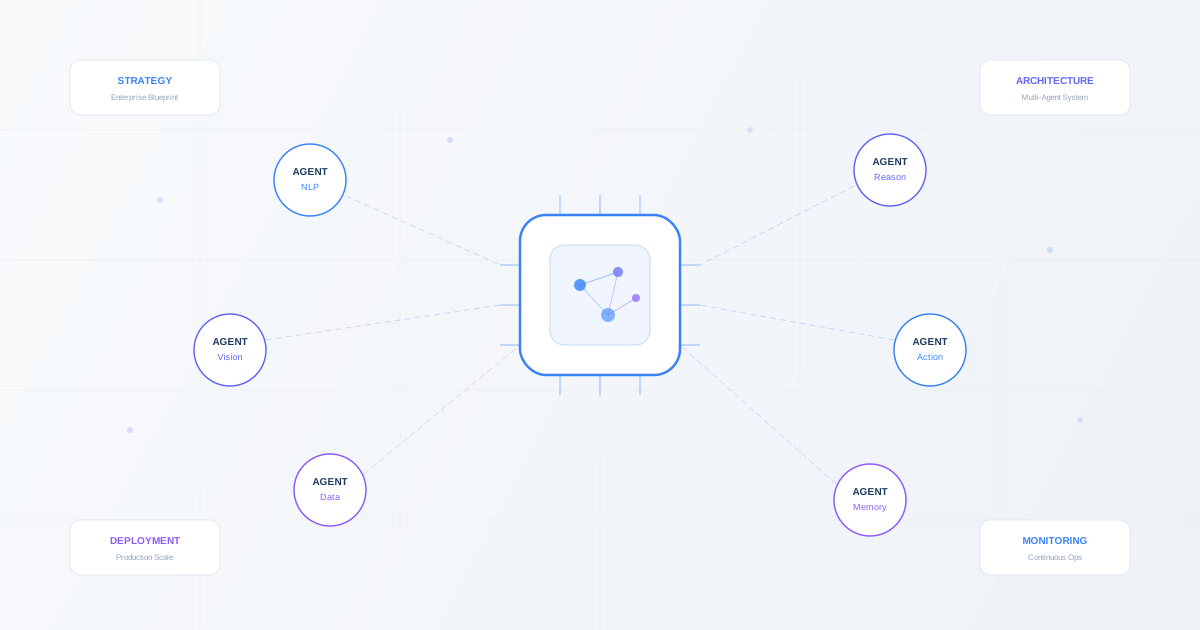
Whatever name is on the product, nearly every conversational AI system runs the same seven stage pipeline. For text channels the two speech stages drop out. For voice channels they are the hardest and most latency sensitive part of the system.
| Stage | What it does | Example technologies | What to watch |
|---|---|---|---|
| 1. Speech to text | Converts streaming audio into text with word timestamps and detects when the speaker has finished | Whisper, Deepgram, Google Speech to Text, Azure Speech, Amazon Transcribe | Word error rate on accents, drug names, and 8 kHz phone audio |
| 2. Understanding | Works out what the person wants and extracts entities such as dates, names, and member IDs | Rasa, Dialogflow CX, Amazon Lex, OpenAI, Anthropic Claude, Google Gemini | Ambiguity, two requests in one utterance, sarcasm |
| 3. Dialogue management and state | Tracks where the conversation is, what has been collected, and what is still needed | Rasa flows, Dialogflow CX pages, custom state machines, agent orchestration frameworks | Lost context across turns, loops, dead ends |
| 4. Retrieval and grounding | Pulls facts from documents and records so the answer rests on real data | Vector search, enterprise search APIs, FHIR and CRM lookups | Stale documents, wrong record matched to the caller |
| 5. Tool calling and integrations | Executes actions: book, cancel, verify eligibility, open a ticket | Function calling in OpenAI, Claude, and Gemini; Model Context Protocol; EHR, CRM, and ITSM APIs | Permissions, idempotency, partial failures |
| 6. Response generation | Composes the reply in the right tone, length, and language | LLM APIs, templated responses for regulated wording | Hallucination, replies too long to speak aloud |
| 7. Text to speech | Turns the reply into natural audio | ElevenLabs, Azure Speech, Google Text to Speech, Amazon Polly, Cartesia | Time to first audio byte, pronunciation of names |
In production these stages overlap rather than run in sequence. The recognizer streams partial transcripts while the person is still talking, the model starts generating as soon as the utterance is judged complete, and the synthesizer begins speaking the first sentence before the last one is written. The orchestration layer that manages this overlap, plus the connectors into the EHR, CRM, or ticketing system, is where most custom engineering lands. That is the work described on our AI integration services page.
NLU versus LLM understanding
In an intent based system, a classifier maps each utterance to one of a fixed list of intents, and a slot filler extracts the required values. The behavior is predictable and cheap to run, but every intent, phrase variation, and edge case is designed by hand. In an LLM based system, the model reads the system prompt, the conversation so far, and any retrieved context, then decides what the person means and what to do next. It handles phrasing it has never seen, at the cost of higher latency, higher per turn cost, and the possibility of a confident wrong answer.
Most serious deployments are hybrid. The model handles understanding and phrasing, while deterministic code handles anything that involves money, protected health information, or a commitment to the customer. A model may propose an appointment time; a function checks that the slot exists and books it. Choosing and tuning the model for this role, including whether a smaller open weight model can run privately, is the core of LLM development.
Conversational AI vs Chatbot vs Virtual Assistant vs AI Agent vs IVR
Buyers hear five terms used as if they were interchangeable. They are not, and the differences decide what you are paying for. The table gives the working definitions we use.
| Term | What it is | Understands free language | Takes actions in systems | Typical example |
|---|---|---|---|---|
| Chatbot | Any software that chats; historically scripted or button driven | Sometimes | Rarely | Website FAQ widget with menu buttons |
| IVR | Phone menu driven by keypad or a small fixed speech grammar | Limited to preset phrases | Routes calls only | Press 1 for billing, say your account number |
| Conversational AI | Umbrella category for systems that understand and respond in natural language on any channel | Yes | Depends on integrations | Voice assistant that books and confirms an appointment |
| Virtual assistant | Consumer or employee facing assistant that spans many tasks | Yes | Within its own ecosystem | Siri, Alexa, an employee help desk assistant |
| AI agent | Goal driven system that plans, calls tools, and completes multistep work; conversation optional | Yes | Yes, that is its purpose | Agent that works a claim denial to resolution |
Conversational AI vs chatbot is a category versus instance question. Every modern chatbot with real language understanding is conversational AI. Not every conversational AI is a chatbot, because voice assistants belong to the category too. An AI agent may have no conversational surface at all; it can be triggered by an event and report to a queue, which is the design pattern behind AI agent development.
IVR replacement is the most common voice project in the enterprise. Callers hate menus, misroutes are expensive, and a natural language front end can classify the reason for the call in one sentence and either resolve it or route it correctly. When the front end also completes tasks such as scheduling or payments, it has become a full voice assistant of the kind described on our voice agent page.
Types of Conversational AI
There are two useful ways to classify conversational AI: by the channel the person uses, and by the architecture that understands them. Most buying decisions pick one of each.
By channel
- Text. Web chat, SMS, WhatsApp, Apple Messages for Business, Slack and Microsoft Teams, and in app messaging. Text can show buttons, links, forms, and images, and the person can read at their own pace. Latency of two or three seconds is tolerable.
- Voice. Phone lines, smart speakers, in car assistants, and kiosks. Voice adds speech recognition and synthesis, removes the visual fallback, and demands turn taking that feels human. It is also where most enterprise volume sits, because the phone is still the default channel for older patients and for anything urgent.
- Multimodal. Voice plus a screen, image or document upload, or a video avatar. A patient can photograph an insurance card while talking, or a field technician can show a fault while asking a question. Multimodal models that accept images and audio directly have made this practical since 2024.
Voice bots vs chatbots is mostly a question of what changes when you remove the screen. A chatbot can present five appointment slots as buttons. A voice bot has to read two or three aloud and confirm the choice. A chatbot can display a policy paragraph; a voice bot has to summarize it in a sentence. Identity verification, spelling of names, and reading back long identifiers are all harder by voice, and every stage of the pipeline has to finish inside a strict time budget.
By architecture
- Rule based. Decision trees, keyword rules, and button flows. Fully predictable, cheap to run, easy to audit, and brittle. Right for a handful of fixed paths where wording must be exact, such as consent scripts.
- Intent based. An NLU classifier plus designed flows, the Dialogflow and Amazon Lex pattern. Good for bounded tasks with a few dozen intents, such as IVR routing or order status. Requires ongoing training phrase maintenance as language drifts.
- Generative. A large language model handles understanding and phrasing, with retrieval to ground it in your content. Handles open questions and long tail phrasing. Needs guardrails, grounding, and evaluation, which is the scope of generative AI development.
- Agentic. A model plus planning, memory, and tool calling that completes tasks across systems, with human checkpoints on high stakes actions. The most capable and the most demanding to govern.
Pick the architecture by the cost of an error, not by novelty. A password reset assistant can be generative with a deterministic reset function behind it. A consent disclosure should be rule based so the wording never varies. A scheduling assistant that writes to an EHR should be agentic in structure but with hard coded checks around every write.
Enterprise Use Cases by Function
The use cases that work share three traits: high volume, a bounded set of tasks, and data reachable through an API. Where any of the three is missing, the assistant becomes an expensive FAQ page.
- Customer service. Order status, returns and exchanges, billing questions, address changes, appointment changes, and password resets. The assistant resolves tier one contacts and hands the rest to a human with a transcript summary and the fields already collected, so the person does not repeat themselves.
- IT help desk. Password and MFA resets, access requests with approval routing, device troubleshooting from the knowledge base, and ticket creation in ServiceNow or Jira Service Management with the right category and priority. Help desk volume is predictable and the systems have mature APIs, which makes it a common first project.
- Sales and marketing. Qualifying inbound website chats and phone calls, answering product questions grounded in the catalog, and booking meetings directly into Salesforce or HubSpot. Outbound use is legally constrained, which we cover in the regulation section below.
- HR and employee services. Benefits questions during open enrollment, leave policy, onboarding checklists, and payroll queries with lookups into Workday or SAP SuccessFactors. Employees ask the same fifty questions every year, and the answers live in documents nobody reads.
- Finance and collections. Balance inquiries, payment reminders, and payment plan setup. Debt collection calls fall under the FDCPA and the CFPB's Regulation F, effective November 30, 2021, which limits call frequency and requires specific disclosures, so these flows are typically rule based around a generative core.
A text first assistant for any of these functions, grounded in your knowledge base and connected to your systems, is the standard scope of an enterprise chatbot project. Voice adds the speech stages and the latency work described later in this guide.
Conversational AI in Healthcare
Healthcare has the highest volume of routine phone work of any industry and the strictest rules about the data in those calls. Front desks field scheduling, refills, directions, billing, referral status, and results questions all day, and most of them never need a clinician. That combination is why conversational AI in healthcare has moved faster than in most sectors since 2023, and why it is also where the compliance work is heaviest.
- Scheduling and rescheduling. The assistant reads open slots through FHIR R4 Appointment, Schedule, and Slot resources or HL7 v2 SIU messages, books into Epic, Oracle Health, athenahealth, or MEDITECH, and confirms by text. Paired with reminders and waitlist backfill, this is the workflow behind our no show prevention agent.
- Refill requests. Capture the medication, pharmacy, and last fill date, check the active medication list, and route the request to the prescriber for approval. Renewal messages between pharmacies and prescribers travel over the NCPDP SCRIPT standard. The assistant never approves a refill itself, and controlled substances always go to a human.
- Intake and registration. Demographics, insurance details, consent forms, and history collected before the visit, with eligibility verified over an X12 270/271 transaction so coverage problems surface before the patient arrives rather than at checkout.
- Symptom triage. Structured questioning aligned to nurse triage protocols such as Schmitt-Thompson, an acuity level mapped to the Emergency Severity Index, and immediate escalation to a nurse or 911 on red flag symptoms such as chest pain or stroke signs. Triage is routing, not diagnosis, and the boundary must be explicit. See how we structure it on the patient triage agent page.
- Post discharge follow up. Outbound check ins at 48 hours and 7 days covering medication reconciliation, symptoms, and follow up appointments, with concerns routed to a care manager. These calls support readmission programs measured under the CMS Hospital Readmissions Reduction Program.
- Payer member services. Eligibility and benefits, ID card requests, claim status, and prior authorization status. The CMS Interoperability and Prior Authorization Final Rule (CMS-0057-F, January 2024) requires impacted payers to expose Prior Authorization APIs by January 2027, which gives assistants a standard data source for status questions that today take a fifteen minute hold.
Every one of these touches protected health information, so identity verification before disclosure, a business associate agreement with every vendor in the chain, and audit logging of each data access are requirements rather than options. The full catalog of clinical and administrative agents we build is on the healthcare AI agents page, and clinics that mainly need the phone answered can start with an AI receptionist.
What Makes Production Hard
A convincing demo takes a week. A system that answers real callers, writes to real records, and survives an audit takes months, and the gap is almost never the model. These are the problems that consume the schedule.
Hallucination and grounding
Left alone, a language model will state a clinic opening time or a refund policy that does not exist. Grounding means the model answers only from retrieved sources, facts such as hours and prices come from deterministic lookups rather than generation, and the assistant says it does not know when no source supports an answer. Groundedness has to be measured on a labeled sample, not assumed from a prompt instruction.
Latency, turn taking, and barge in
In human conversation the gap between one speaker finishing and the next starting averages about 200 milliseconds across languages, according to a 2009 cross linguistic study by Stivers and colleagues published in PNAS. A voice assistant cannot match that, but it has to respond in well under one second, with most teams targeting 500 to 800 milliseconds from end of speech to first audio. That budget is shared across endpointing, model time to first token, synthesis time to first byte, and network hops, so every stage must stream.
Barge in is the ability to stop talking the instant the caller interrupts, discard the rest of the planned reply, and listen. Endpointing, deciding that the caller has actually finished rather than pausing to find a word, is the harder twin. Cut in too early and you talk over people; wait too long and the line goes silent. Both are tuned per use case, and both are invisible in a text demo.
Accents, noise, and vocabulary
Word error rates that look fine on a benchmark rise on narrowband phone audio, regional accents, speakerphones, and specialized vocabulary such as drug names and surnames. Mitigations include custom vocabulary boosting, confirming spellings, reading identifiers back digit by digit, and designing flows so a single misheard word cannot commit an action.
Escalation to humans
Every assistant needs a clear path to a person: on request, after repeated failure, on detected frustration, and immediately on high risk topics such as self harm or acute symptoms. A warm transfer passes the transcript, the collected fields, and a one line summary so the human starts where the assistant stopped. The escalation policy is a product decision that clinical, legal, and operations leads should sign, not something left to a prompt.
PHI, consent, and recording
Transcripts, audio, logs, and the prompts sent to model vendors all contain personal data, and in healthcare they contain PHI. Each vendor in the chain that touches it, including speech, model, and synthesis providers, needs a business associate agreement or equivalent data processing terms, and retention has to be defined rather than defaulted. Recording announcements, identity verification before any disclosure, and the minimum necessary standard all apply to a machine exactly as they apply to a person.
Evaluation
Prompt changes and model upgrades alter behavior in ways nobody can predict by reading them. Production teams keep a regression set of real transcripts and simulated callers, score every change against it for task completion and groundedness, review a random sample of live conversations weekly, and red team the assistant for prompt injection delivered through the caller's own speech. Without this, quality drifts and nobody notices until a complaint arrives.
Conversational AI, Built for Production
Need an Assistant That Actually Completes the Task?
Tell us the calls or chats you want handled and the systems they touch. We map the pipeline, the integrations, the escalation policy, and the compliance controls, then build and run the assistant with you.
Talk to an AI EngineerHow Conversational AI Is Measured
Vendors quote metrics freely and define them inconsistently. The definitions below are the standard ones; agree on them in writing before a pilot so the results are comparable to your human baseline.
| Metric | Definition | Why it matters | Caveat |
|---|---|---|---|
| Containment rate | Share of conversations resolved with no human involvement | Primary cost lever | A caller who gives up and hangs up counts as contained unless you check outcomes |
| Task completion rate | Share of attempted tasks, such as bookings, that finish successfully | Measures delivered value, not deflection | Requires a written definition of success per task |
| Escalation rate | Share of conversations transferred to a person | Shows scope gaps and trust | A very low rate can mean the assistant refuses to transfer |
| Average handle time | Mean duration of a conversation, for the assistant and for humans after transfer | Capacity planning | Shorter is worse if completion falls |
| CSAT | Post interaction satisfaction, usually a 1 to 5 rating | Perceived quality | Response bias; compare with the same survey on human calls |
| First contact resolution | Resolved with no repeat contact on the same issue within a window | True resolution quality | Needs contact matching across channels |
| Groundedness and intent accuracy | Share of answers supported by a source and turns understood correctly | Model quality | Needs labeled samples reviewed by people |
| Latency P50 and P95 | Median and 95th percentile response time | Voice usability | The tail is what callers remember |
Cost per conversation, word error rate, and fallback rate round out the set. None of these are outcomes we claim here; they are the yardsticks any deployment should be held to, and the pilot should report all of them, not the two that look best.
Regulation and Compliance
Conversational AI is regulated today under laws that predate it, plus a growing set of AI specific rules. The four that come up in every US enterprise deployment are below, with the healthcare and EU additions that follow.
- TCPA (outbound calls and texts). The Telephone Consumer Protection Act of 1991, 47 U.S.C. 227, restricts calls made with an artificial or prerecorded voice to mobile phones without prior express consent, and requires prior express written consent for marketing. In a declaratory ruling issued in February 2024, the FCC confirmed that AI generated voices are artificial voices under the TCPA. Statutory damages run $500 per violation and up to $1,500 for willful violations, and class actions are common. Inbound calls that the customer initiates are not the issue; outbound campaigns are.
- HIPAA (protected health information). The Privacy and Security Rules at 45 CFR Parts 160 and 164 apply to any assistant that creates, receives, maintains, or transmits PHI on behalf of a covered entity. That means a business associate agreement with each vendor in the chain, the technical safeguards in 45 CFR 164.312 for access control, audit logging, and encryption, and breach notification duties. HHS Office for Civil Rights enforces, with civil penalties tiered by level of culpability.
- Call recording and biometrics. Federal law at 18 U.S.C. 2511 requires one party consent, but roughly a dozen states require all parties to consent, including California under Penal Code 632, Florida, Illinois, Pennsylvania, Washington, Massachusetts, and Maryland. A recording announcement at the start of every call is the practical standard. If you use a caller's voice to identify them, the Illinois Biometric Information Privacy Act (740 ILCS 14) treats voiceprints as biometric identifiers requiring written consent, with a private right of action.
- FTC and state disclosure rules. Section 5 of the FTC Act covers deceptive claims about what an AI can do and undisclosed bots. The FTC's 2023 guidance, Keep Your AI Claims in Check, and its September 2024 Operation AI Comply enforcement sweep made the position explicit. California's bot disclosure law (Business and Professions Code 17940) requires disclosure when a bot is used to sell or influence a vote, and Utah's Artificial Intelligence Policy Act, effective May 1, 2024, requires disclosure on request and proactive disclosure in regulated occupations including healthcare.
In the European Union, Regulation (EU) 2024/1689, the AI Act, entered into force on August 1, 2024. Article 50 requires providers to ensure that people are informed they are interacting with an AI system unless it is obvious from context, and those transparency obligations apply from August 2, 2026. Some healthcare and insurance uses may fall into the Annex III high risk categories, which bring risk management, documentation, and human oversight requirements on top of disclosure. The practical rule everywhere is the same: say it is an AI at the start, make a human reachable, and log what was said.
Build vs Buy: Conversational AI Platforms and Categories
The market for conversational AI platforms splits into five categories, and most enterprise systems combine at least two of them. Knowing which layer a vendor sells prevents comparing a telephony suite with a model API as if they were alternatives.
- CCaaS and contact center suites. Genesys Cloud CX, NICE CXone, Five9, Talkdesk, Amazon Connect, and Twilio Flex bundle telephony, routing, workforce tools, and increasingly native bots. The right choice when the contact center already runs on one and the use cases are generic.
- Conversational AI platforms and bot builders. Dialogflow CX, Amazon Lex, Microsoft Copilot Studio, Kore.ai, and Rasa offer visual flow design, NLU, analytics, and channel connectors. Fast for bounded intent based assistants; the ceiling shows up when flows need deep custom integration.
- LLM APIs. OpenAI, Anthropic Claude, and Google Gemini, plus open weight models such as Meta Llama and Mistral for private hosting. This is the reasoning layer only. Everything else in the pipeline still has to be built or bought.
- Voice infrastructure. Telephony from Twilio, Telnyx, or SIP trunks; real time media frameworks such as LiveKit and Pipecat; and the speech vendors listed in the pipeline table. Voice quality and latency are decided here, not in the model.
- Open source frameworks and custom builds. Rasa, LangGraph, LlamaIndex, and Pipecat provide the skeleton; a custom build assembles them with your own state management, integrations, guardrails, and evaluation harness. Highest control, highest responsibility.
When to build
Build when the workflow needs deep write access to systems of record such as an EHR or a claims platform, when data residency or a private model is required, when the experience is part of how you compete, or when per minute platform pricing stops making sense at your volume. Buy when the use case is generic, the platform already supports your channels, and you have nobody to run a model stack. Many organizations buy the contact center layer and build the assistant that sits on it, which is the combination our integration team most often delivers.
A short buyer checklist
- Which systems must the assistant read and write, and do they expose APIs such as FHIR, REST, or HL7 v2 today?
- Text, voice, or both in year one, and on which channels? Voice roughly doubles the engineering scope.
- Where does personal or protected data flow, and will every vendor in the chain sign a BAA or data processing agreement?
- What is the escalation path, who staffs it, and at what hours?
- What P95 latency does the vendor commit to for voice, measured end to end on real phone audio?
- How is the model grounded, can it decline to answer, and how is groundedness measured?
- What regression testing and live monitoring exist before and after each change?
- How is pricing structured, per minute, per conversation, or per seat, and what does it cost at three times your current volume?
- Can you export transcripts, flows, and evaluation data if you leave?
Answer these before a demo and the demo becomes far more useful, because you will be watching the stages that fail in production rather than the ones that always look good on a stage.
Frequently Asked Questions
[ 1 ]What is conversational AI in simple terms?
Conversational AI is software that understands what a person says or types in ordinary language and replies in a natural dialogue to answer a question or complete a task. It combines speech recognition, language understanding, dialogue management, and language generation. Chatbots, voice assistants, and virtual assistants are all forms of conversational AI.
[ 2 ]How does conversational AI work?
Conversational AI runs a pipeline. Speech to text converts audio into words, a language model or NLU engine works out what the person means, a dialogue manager tracks what has been collected and what is still needed, retrieval pulls facts from documents or records, tool calling performs actions such as booking or verifying, response generation composes the reply, and text to speech speaks it. In voice systems these stages overlap and stream so the whole loop finishes in well under one second.
[ 3 ]What is the difference between conversational AI and a chatbot?
Conversational AI is the category; a chatbot is one kind of product within it. Chatbots have historically been scripted or button driven and text only, while conversational AI includes voice assistants and systems that understand free language and take actions in other systems. Every modern chatbot with real language understanding is conversational AI, but not every conversational AI is a chatbot.
[ 4 ]What are the main types of conversational AI?
By channel, conversational AI is text, voice, or multimodal. By architecture, it is rule based (fixed decision trees), intent based (an NLU classifier with designed flows, the Dialogflow and Amazon Lex pattern), generative (a large language model grounded in your content), or agentic (a model with planning and tool calling that completes tasks across systems). Most enterprise deployments pick one channel type and one architecture, and many are hybrids.
[ 5 ]What are examples of conversational AI in business?
Common conversational AI examples include customer service assistants that handle order status and returns, IT help desks that reset passwords and open tickets in ServiceNow, sales assistants that qualify leads and book meetings into a CRM, HR assistants that answer benefits and leave questions, and healthcare assistants that schedule appointments, take refill requests, and run intake. The pattern is high volume, bounded tasks with data reachable through an API.
[ 6 ]How is conversational AI used in healthcare?
Conversational AI in healthcare handles appointment scheduling through FHIR or HL7 v2 interfaces, medication refill requests routed to prescribers, patient intake and eligibility checks, protocol based symptom triage with escalation to nurses, post discharge follow up calls, and payer member services such as claim and prior authorization status. Because every one of these involves protected health information, HIPAA business associate agreements, identity verification, and audit logging are required.
[ 7 ]What is the difference between voice bots and chatbots?
Voice bots add speech recognition and speech synthesis and remove the screen, so they have to respond in under a second, handle interruptions, confirm spellings, and read options aloud instead of showing buttons. Chatbots work in text, can display links, forms, and images, and tolerate a few seconds of delay. Voice is harder to build but carries most enterprise contact volume, especially for older customers and urgent issues.
[ 8 ]Which conversational AI platforms should an enterprise consider?
Conversational AI platforms fall into five categories: contact center suites such as Genesys Cloud, NICE CXone, Five9, and Amazon Connect; bot builders such as Dialogflow CX, Amazon Lex, Microsoft Copilot Studio, Kore.ai, and Rasa; LLM APIs from OpenAI, Anthropic, and Google; voice infrastructure such as Twilio, LiveKit, Deepgram, and ElevenLabs; and open source frameworks or custom builds. Most enterprise systems combine two or more, so compare vendors by the layer they actually provide.
[ 9 ]Does conversational AI have to tell people it is an AI?
Increasingly, yes. Article 50 of the EU AI Act requires that people be informed they are interacting with an AI system unless it is obvious, with obligations applying from August 2, 2026. In the United States, Utah's Artificial Intelligence Policy Act requires disclosure on request and proactively in regulated occupations, California requires bot disclosure in sales and political contexts, and the FTC treats undisclosed bots and inflated AI claims as potentially deceptive under Section 5. Disclosing at the start of every conversation is the safe default.
[ 10 ]Is ChatGPT a conversational AI?
Yes. ChatGPT is a generative, LLM based conversational AI: it understands natural language, keeps context across turns and produces free form answers. It differs from an enterprise conversational AI deployment in that a business system is grounded in the company's own data, connected to backend tools, constrained by guardrails and measured on task completion rather than open ended chat.
[ 11 ]Which conversational AI platform is best?
There is no single best platform. Contact center suites such as Genesys, NICE, Five9 and Talkdesk fit teams that already run those platforms. Hyperscaler services such as Google Dialogflow and Vertex AI, Amazon Lex and Azure AI fit engineering teams that want managed building blocks. LLM APIs from OpenAI, Anthropic and Google plus voice stacks from Deepgram or ElevenLabs fit custom builds, and open source frameworks such as Rasa fit organizations that need full control and on premise deployment. Choose by channel, integration depth, compliance requirements and who will maintain it.