
Key takeaways
- An AI agent example worth studying is one running in production with real users, not a demo. Every example on this page is a live Bonami agent with its own detail page.
- The agents that survive share a pattern: one narrow workflow, deep integration with existing systems, a human approval step, and a measured baseline.
- The highest ROI examples are repetitive, rules-heavy work: eligibility checks, coding, reconciliation, invoice exceptions, and RFP answers.
- Fully autonomous agents rarely survive contact with real users. Human-in-the-loop design is why these 32 are still running.
What is an AI agent example?
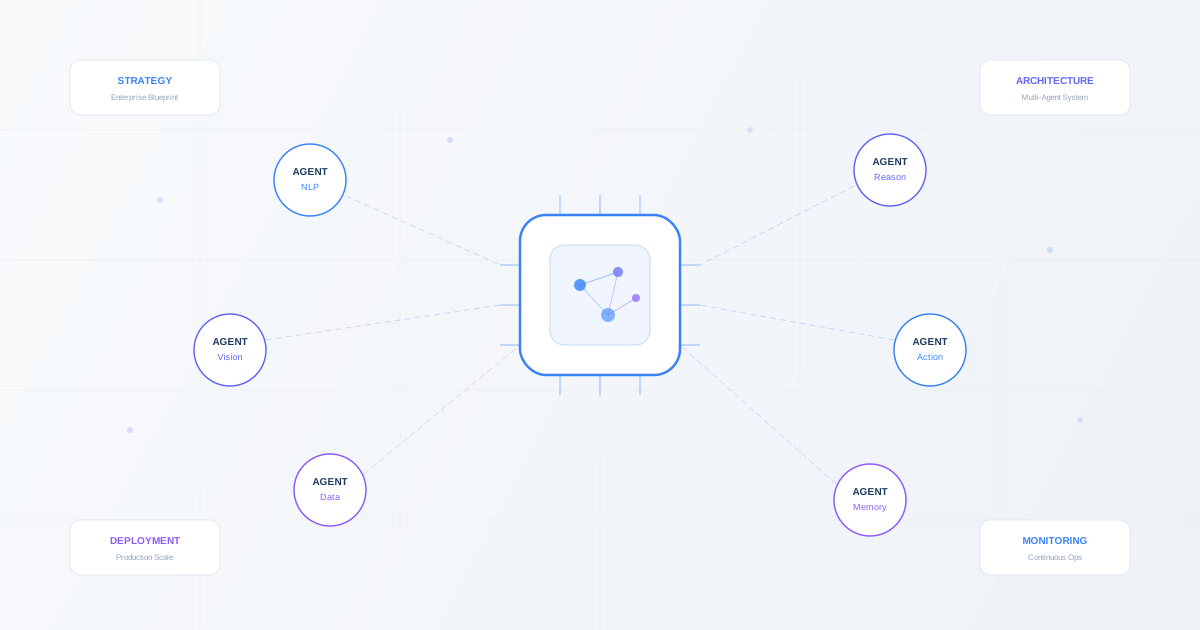
An AI agent is software that uses a large language model to perceive context, make a decision, and take an action inside business systems, rather than just answering a question. A useful AI agent example therefore shows all three parts: what the agent reads, what it decides, and what it does. The examples below are 32 agents Bonami runs in live enterprise environments, grouped by function, each with the problem it solves and the result it measures. Every one links to a full page describing how it works.
What counts as production on this page
- Real users depend on the agent for daily work, not a pilot group evaluating it.
- The agent acts inside live systems: EHRs, ERPs, CRMs, clearinghouses, ticketing tools.
- A human approves or can override the important actions. None of these are fire and forget.
- There is a measured baseline, so the numbers quoted are before and after comparisons from the agent pages, not projections.
Healthcare and clinical AI agent examples
Healthcare is where agent design gets hardest: protected data, clinical risk, and audit requirements. It is also where the manual workload is largest, which is why these six examples produce some of the clearest returns.
| Agent | What it does | Measured result |
|---|---|---|
| Clinical documentation agent | Ambient AI medical scribe that drafts SOAP notes from each encounter for physician sign off | Cuts physician documentation time by about 50% |
| Patient triage agent | Structured symptom collection with ESI aligned acuity scoring and routing | Reduces avoidable ED visits |
| Patient intake and history agent | Automates online intake, verifies insurance, and pre populates the EHR before the visit | Complete histories ready before the patient arrives |
| Post discharge follow up agent | Automated outreach, symptom monitoring, and adherence verification after discharge | Cuts readmissions |
| Appointment no show prevention agent | Predictive risk scoring plus automated reminders calibrated to each patient | Cuts no shows by up to 50% |
| Hospital operations agent | Bed management, OR scheduling, and supply chain prediction for hospital operations | Predicts bed availability instead of firefighting |
Revenue cycle AI agent examples
Revenue cycle work is deadline driven, rules heavy, and measured in thousands of items per month, which makes it the single best fit for agents we have found. These six run as part of our AI revenue cycle management software.
| Agent | What it does | Measured result |
|---|---|---|
| Eligibility verification agent | Automated insurance verification across 900+ payers before every visit | Cuts eligibility denials by up to 80% |
| Prior authorization agent | Reads payer policy, drafts the PA packet, submits, and tracks status to outcome | Cuts authorization turnaround from days to hours |
| Medical coding agent | Reads clinical documentation and assigns ICD-10 and CPT codes with NCCI edit validation | Coder time shifts from lookup to review |
| Charge capture agent | Detects missed charges and billing errors from clinical documentation | Reduces revenue leakage |
| Denial management agent | Classifies every 835 ERA by root cause and drafts payer specific appeals | Recovers denied revenue systematically |
| Underpayment recovery agent | Audits every remittance against contracted rates and disputes variances | Finds money nobody had time to look for |
Want one of these in your stack?
We scope an agent against a measurable outcome before any build starts.
Talk to Our AI Agent TeamFinance and accounting AI agent examples
| Agent | What it does | Measured result |
|---|---|---|
| Cash application agent | Matches incoming payments to invoices and posts cash to the ERP in real time | Real time posting instead of end of day batches |
| Autonomous reconciliation agent | Transaction matching and month end close automation | 92 to 97% auto match rates |
| Invoice exception handler | Detects, classifies, and resolves accounts payable exceptions | Exception rates under 4% |
| Revenue recognition agent | Automated revenue recognition under ASC 606 and IFRS 15 | Cuts revenue close cycle time by up to 75% |
| Expense policy compliance agent | Real time T&E policy enforcement and fraud detection | 100% audit coverage instead of sampling |
Procurement and vendor AI agent examples
| Agent | What it does | Measured result |
|---|---|---|
| Purchase requisition advisor | Automates requisition intake, policy validation, budget checks, and approvals | Cuts cycle time by up to 70% |
| Spend categorization agent | Automated spend categorization across every source system | 95% categorization accuracy |
| Vendor risk monitor agent | Continuous third party risk intelligence with real time scores | Early warning instead of annual reviews |
| Contract clause review agent | Extracts, classifies, and risk scores every clause in NDAs, MSAs, and vendor contracts | Consistent review at volumes legal cannot staff |
Sales and revenue operations AI agent examples
| Agent | What it does | Measured result |
|---|---|---|
| Deal forecast agent | Scores every open deal and automates forecast roll ups | Flags at risk deals 30 days early |
| Pipeline hygiene agent | Enforces CRM data hygiene and detects stale opportunities | A forecast sales leaders can trust |
| CPQ pricing advisor | AI guided deal pricing, discount management, and quote automation | Faster quotes with protected margins |
| Renewal risk agent | Scores churn risk on every account and triggers retention playbooks | Acts 90 days before cancellation |
| RFP response agent | Retrieves approved answers and drafts proposal responses | Answers 70% of bid questions automatically |
Why these AI agents survived production
For every example above, several more ambitious designs did not make it. The survivors share five traits, and they are worth more than any individual example on this page.
- One narrow workflow. "Handle the back office" fails. "Verify eligibility for tomorrow's appointments" survives.
- A human on the approve button. Regulated buyers do not accept full autonomy, and trust dies the first time an agent is confidently wrong.
- Deep integration. The agent works inside the EHR, ERP, or CRM your team already uses, not beside it.
- A measured baseline. Every agent here had its manual process timed before launch, which is why the results are comparisons rather than claims.
- Full audit logging. When someone asks why the agent did something, there is an answer.
If you are evaluating partners to build agents like these, our guide to the best AI agent development companies covers how to compare custom build partners and platforms. For the build itself, see our AI agent development services or the full Bonami X AI portfolio these examples come from.
Frequently asked questions
What is an example of an AI agent?
An eligibility verification agent is a clear example: it reads tomorrow's appointment list, queries payer systems for each patient's coverage, flags problems, and files the results in the EHR. It perceives, decides, and acts inside real systems, which is what separates an AI agent from a chatbot.
What is the difference between an AI agent and a chatbot?
A chatbot answers questions in a conversation. An AI agent completes work: it takes actions in business systems like submitting a prior authorization, posting cash to an ERP, or opening a remediation ticket. Most agents run on the same underlying language models but add tools, permissions, and workflow logic.
What are the most common AI agent use cases?
Across the 32 examples here, the biggest clusters are revenue cycle automation (eligibility, prior auth, coding, denials), finance operations (reconciliation, cash application, invoice exceptions), and clinical support (documentation, triage, intake). The common thread is high volume, repetitive decisions with clear rules.
How do companies measure AI agent ROI?
Time the manual process before the agent launches, then compare: minutes per item, items per month, error and denial rates, and recovered revenue. Every agent on this page had that baseline measured first, which is how results like an 80% cut in eligibility denials or 92 to 97% auto match rates are known rather than estimated.
Are these AI agents fully autonomous?
No, and that is deliberate. Each one drafts, flags, or recommends, and a human approves the consequential actions. In healthcare and finance this is a compliance requirement, but it is also why the agents keep running: teams trust systems they can override.