Shared state
Nine players, nine devices, one hand in progress. Each client has to see the same pot, the same action and the same clock, and the server has to remain the only authority on all three.
PokerBaazi is one of India's largest homegrown poker platforms, built by Baazi Games. Thousands of simultaneous tables, synchronised turn by turn across mobile networks, on infrastructure where a dropped connection has to be handled as a rules question rather than a refresh.
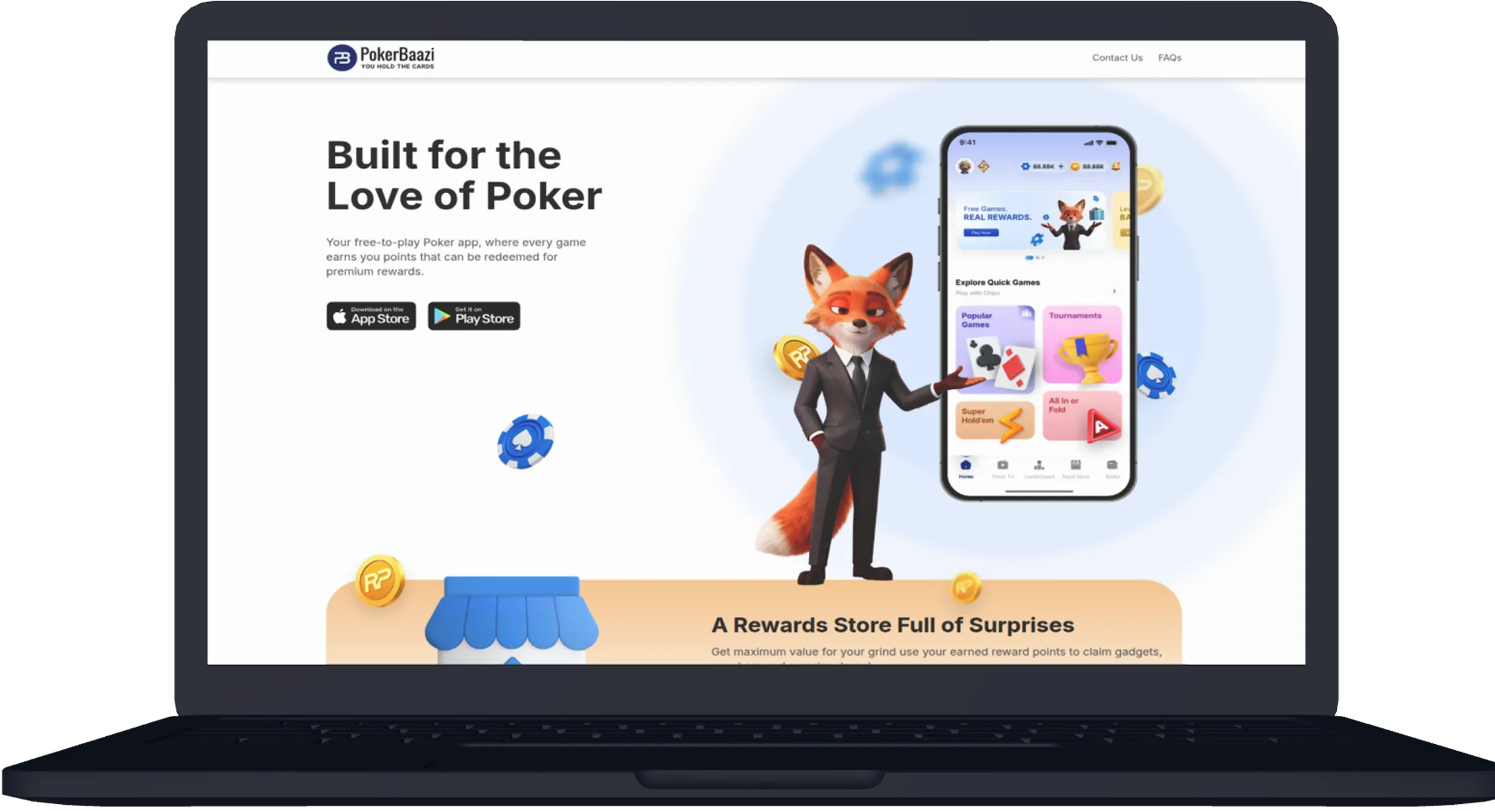
Build Your Real-Time PlatformPokerBaazi is the poker vertical of Baazi Games, an Indian skill-gaming company founded in 2014 that also operates BalleBaazi for fantasy sports and RummyBaazi for rummy. The platform runs Texas Hold'em and Pot Limit Omaha cash games and tournaments, and states a registered base of more than six million players. Following India's 2025 online gaming legislation, PokerBaazi moved to a mobile-first, subscription-based free-play model in which players earn redeemable reward points — a change in commercial model that leaves the underlying real-time engineering problem unchanged.
A category where the software is the game: correctness, fairness and latency are the product, and a defect is visible to every player at the table at once.
Baazi Games states PokerBaazi is home to more than six million players, running scheduled tournaments alongside continuous cash games.
The stack recorded for this project: persistent socket connections carrying table state, Redis holding the state that cannot wait on a database, MongoDB for durable records and AWS underneath.
One audience plays a few hands on a commute, the other plays several tables at once for hours. The same client has to serve both without favouring either.
A platform in this category has to hold a synchronous game together over inconsistent mobile connectivity, and absorb regulatory shifts that change the commercial model without rewriting the game engine.
Scope a real-time multiplayer, live-event or high-concurrency consumer platform.
Every player holds a view of the same hand, and any divergence between those views is not a bug report — it is a dispute about money.



Engineering for consumer scale where correctness is non-negotiable.
Persistent connections, server-authoritative state and in-memory game data are a different discipline from request-response product work, and the constraints show up in every architectural choice.
Variable connectivity is the design baseline. Reconnection, state recovery and message efficiency matter more here than they would for a product used on office broadband.
In-memory state and socket transport are chosen because a database round trip per player action would be visible at the table — not as defaults, but as answers to a specific latency budget.
Skill gaming in India has seen its commercial model redefined by legislation. Platforms in this space need a game engine that survives a change in how play is monetised.