
Key takeaways
- An AI agent development company designs, builds, and operates autonomous AI agents that perceive context, reason over it, and take actions to complete business tasks with little human input.
- The best partners bring tested agent frameworks, enterprise integrations, and compliance experience, so you reach production in weeks instead of running long in-house experiments.
- For regulated industries like healthcare and finance, domain depth and a compliance track record matter more than raw access to a model.
- Choose by fit: match a partner's industry experience, integration depth, and shipped agents to your use case, not by brand name alone.
What is an AI agent development company?
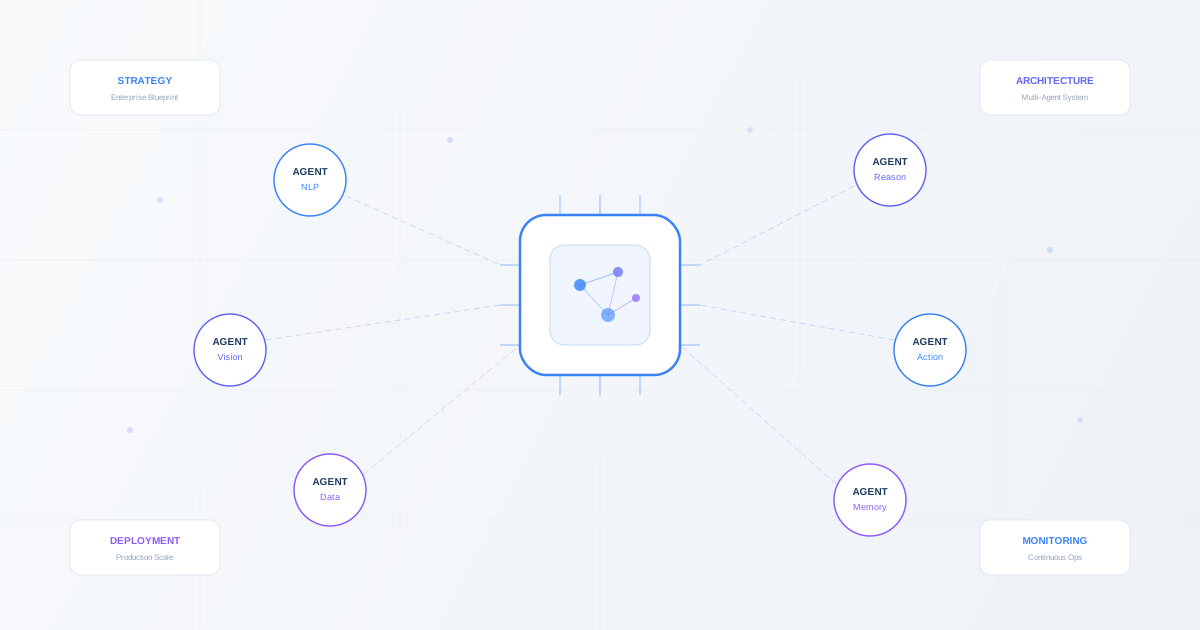
An AI agent development company builds autonomous AI agents: software that perceives context, reasons over it, and takes actions to complete tasks with little or no human input. Unlike a chatbot that only answers questions, an AI agent can plan a multi-step task, call tools and enterprise systems, and finish work end to end. The strongest companies own the full lifecycle, from discovery and model selection through integration, guardrails, compliance, and ongoing optimization once the agent is live.
These companies fall into two groups. Platforms give you pre-built tooling and APIs to assemble agents yourself. Custom build partners, or agencies, design and deliver production agents around your specific workflows. This guide compares the leading options in both groups for 2026, with a focus on enterprise and regulated-industry use.
AI agent development companies at a glance
A quick comparison of the companies covered in this guide, by type, ideal use case, and standout strength.
| Company | Type | Best for | Standout strength |
|---|---|---|---|
| Bonami Software | Custom build partner | Regulated industries needing compliance-ready custom agents | 32 production agents; healthcare, revenue cycle, and fintech depth; end-to-end delivery |
| LeewayHertz | Custom build partner | Full-stack enterprise GenAI platform builds | Broad, established AI portfolio |
| Moveworks | Platform | Enterprise IT and employee-support copilots | Pre-integrated platform for large enterprises |
| OpenAI | Platform | Teams building directly on frontier models | GPT models with Assistants and Agents APIs |
| Google Cloud (Vertex AI) | Platform | GCP-native enterprises | Agent Builder and infrastructure scale |
| Appinventiv | Custom build partner | Product startups and enterprises needing app plus AI | Large delivery team with app heritage |
| N-iX | Custom build partner | Enterprises needing engineering scale | Deep nearshore engineering bench |
| Master of Code Global | Custom build partner | Conversational AI and gen-AI assistants | Conversational design depth |
| SoluLab | Custom build partner | Startups and mid-market | Cost-effective, broad stack |
| Markovate | Custom build partner | AI product strategy plus build | Consulting-led delivery |
How we evaluated these companies
AI agent development is new enough that vendor claims outpace delivered work. We weighed each company on factors that predict whether an agent actually reaches production and stays reliable, rather than on marketing or model access alone.
- Domain expertise: proven experience in your industry, especially where workflows are complex or regulated.
- Integration track record: the ability to connect agents to real enterprise systems such as EHRs, ERPs, and CRMs, not just demo environments.
- Custom build vs. resale: whether the company engineers agents around your workflows or mainly configures a platform you could buy directly.
- Compliance and governance: audit trails, data handling, and human-in-the-loop controls for sensitive actions.
- Shipped agents: named, in-production agents and outcomes, not slideware.
- Ongoing support: monitoring, evaluation, and optimization after launch, since agents drift without it.
Top AI agent development companies in 2026
The companies below are grouped into custom build partners, who design and deliver agents for you, and platforms, which provide tooling to build agents yourself. Most enterprise programs combine the two: a platform underneath, a build partner on top.
Custom AI agent development partners
1. Bonami Software
Bonami Software is a custom software and AI development company that builds production AI agents for enterprises, with particular depth in healthcare, revenue cycle, and fintech, where compliance is non-negotiable. It runs more than 30 named agents across clinical, revenue-cycle, finance, procurement, and HR functions, and delivers end to end rather than handing over a prototype.
- Best for: enterprises in healthcare, finance, and other regulated sectors that need custom, compliance-ready agents.
- Strengths: 32 production agents, deep revenue-cycle and healthcare experience, multi-agent orchestration, and full-lifecycle delivery from discovery to managed run.
- Consider if: you want a single partner to design, integrate, and operate agents inside regulated workflows, not just a platform to self-assemble.
2. LeewayHertz
LeewayHertz is an established AI development firm with a broad portfolio spanning generative AI, agents, and enterprise platforms. It is a common pick for organizations that want a full-stack GenAI build from a single, experienced vendor.
- Best for: full-stack enterprise GenAI platform builds.
- Strengths: broad AI service catalog and a long delivery history.
3. Appinventiv
Appinventiv is a large digital product and app development company that has extended into AI and agent development. It suits teams that need an AI agent built alongside a mobile or web product.
- Best for: product startups and enterprises needing app plus AI in one engagement.
- Strengths: large delivery organization and strong app engineering heritage.
4. N-iX
N-iX is an engineering-led services company with a large nearshore bench, often chosen for AI programs that need significant, sustained engineering capacity.
- Best for: enterprises needing engineering scale across a longer program.
- Strengths: deep engineering bench and delivery maturity.
5. Master of Code Global
Master of Code Global specializes in conversational AI and generative-AI assistants, with strong experience in customer-facing chat and voice experiences.
- Best for: conversational AI and customer-facing assistants.
- Strengths: conversational design depth and a focus on user experience.
6. SoluLab
SoluLab is a broad technology services firm covering AI, blockchain, and product development, often a fit for startups and mid-market teams that want a wide stack from one vendor.
- Best for: startups and mid-market teams.
- Strengths: cost-effective delivery across a broad technology stack.
7. Markovate
Markovate pairs AI product strategy with development, suited to organizations that want help shaping the AI roadmap as well as building it.
- Best for: AI product strategy plus build.
- Strengths: consulting-led, strategy-first delivery.
Building agents in a regulated industry?
Get compliance-ready AI agents built around your workflows.
Talk to BonamiAI agent platforms
Platforms supply the models and tooling to build and run agents. They are powerful, but they put the integration, evaluation, and compliance work on your team unless you pair them with a build partner.
Moveworks
Moveworks offers an enterprise platform focused on IT and employee-support copilots, with pre-integrated tooling aimed at large organizations.
- Best for: enterprise IT and internal employee-support use cases.
- Strengths: pre-integrated platform and large-enterprise focus.
OpenAI
OpenAI provides frontier models plus the Assistants and Agents APIs, giving technical teams direct access to build on top of GPT models.
- Best for: teams building directly on frontier models.
- Strengths: leading models and a fast-moving developer toolset.
Google Cloud (Vertex AI)
Google Cloud Vertex AI offers Agent Builder and the infrastructure to run agents at scale, a natural fit for organizations already standardized on Google Cloud.
- Best for: GCP-native enterprises.
- Strengths: Agent Builder and cloud-scale infrastructure.
Why hire an AI agent development company instead of building in-house?
Building agents from scratch takes more than a capable model. It takes machine learning and prompt engineering, retrieval and tool design, systems integration, evaluation, and the security and compliance work that production demands. Teams that try to do all of this in-house from a standing start usually underestimate the integration and evaluation effort, which is where most agent projects stall.
The data bears this out. Gartner predicts that over 40% of agentic AI projects will be canceled by the end of 2027, citing escalating costs, unclear business value, and inadequate risk controls. Those are precisely the failure modes an experienced partner is built to avoid: scoping to clear value, controlling cost, and designing in governance from the start.
A development partner brings tested frameworks, reference integrations, and patterns learned across many deployments, so a focused agent can reach production in weeks rather than after long internal experimentation. The build-vs-buy decision usually comes down to three questions.
- Speed: do you need a working agent in weeks, or can you fund a multi-quarter internal effort?
- Compliance: does your use case touch regulated data, where mistakes carry legal and financial cost?
- Maintenance: who will monitor, evaluate, and improve the agent once it is live, since agents degrade without ongoing care?
How to choose an AI agent development company
The right partner depends on your industry, your systems, and how much of the work you want to own. Use this checklist to shortlist quickly.
- Match the domain: prioritize partners with shipped agents in your industry, especially if it is regulated.
- Check integrations: confirm they have connected agents to the systems you actually run.
- Confirm custom build: make sure they engineer for your workflows rather than reselling a platform you could buy directly.
- Review compliance: ask how they handle sensitive data, audit trails, and human approval for high-risk actions.
- Ask for proof: request named, in-production agents and the outcomes they delivered.
- Plan for after launch: agree how the agent will be monitored, evaluated, and improved over time.
AI agent development for healthcare and regulated industries
Regulated industries are where partner selection matters most. In healthcare, an agent may touch protected health information, trigger clinical or billing actions, and need a complete audit trail. A generic agent build that ignores these constraints is a liability, not an asset.
Compliance-ready AI agent development means designing for the rules from the start, not bolting them on later.
- Data handling: minimize and protect sensitive data, with encryption in transit and at rest and clear retention rules.
- Audit trails: log every action an agent takes so decisions can be reviewed and defended.
- Human-in-the-loop: require human approval for clinical, financial, or other high-risk actions.
- Domain accuracy: ground agents in verified knowledge and evaluate them against real cases, not generic benchmarks.
This is where Bonami concentrates, with agents across revenue cycle management, clinical documentation, and other healthcare workflows where compliance and accuracy decide whether an agent can be trusted in production.
How much does AI agent development cost?
Cost depends far more on scope than on the model. A scoped pilot that automates one workflow is a modest investment. A multi-agent program integrated across regulated systems, with the governance and monitoring that production requires, is a larger one. The main drivers are the number and complexity of integrations, compliance requirements, and how much orchestration sits between agents.
A practical approach is to start with one high-value, well-bounded use case, prove it in production, then expand. That keeps initial cost contained while building the internal confidence and data needed to scale.
Frequently asked questions
What is AI agent development?
AI agent development is the work of building autonomous software agents that perceive context, reason over it, and take actions to complete tasks with minimal human input, using large language models, tool and function calling, and orchestration.
How do I choose an AI agent development company?
Match the partner's domain expertise to your industry, confirm their integration and compliance track record, make sure they build custom rather than reselling a platform, and ask for named agents already running in production.
How much does it cost to build an AI agent?
It ranges from a modest scoped pilot to a larger multi-agent enterprise program. Cost is driven mainly by the number of integrations, compliance requirements, and orchestration complexity rather than by the model itself.
How long does AI agent development take?
A focused single agent can reach production in a few weeks with an experienced partner. Multi-agent, regulated deployments take longer because of integration, evaluation, and audit requirements.
Can AI agents be built to be HIPAA-compliant for healthcare?
Yes. Healthcare agents can be built compliant with protected data handling, full audit logging, and human-in-the-loop approval for clinical and billing actions, provided compliance is designed in from the start.
How do I hire AI agent developers for custom solutions?
For custom solutions, engage a build partner with named agents in production and depth in your domain, rather than a platform you would have to implement and maintain yourself.